Designing a School for the New Normal
River Grove Elementary needed to perform on multiple levels: a high-functioning learning environment, a resilient piece of infrastructure and a stabilizing presence for its community.
By Rebecca Stuecker, Contributing Writer
When design began on River Grove Elementary School in spring 2020, the Pacific Northwest still carried a reputation as an ideal region for passive design because of the region’s temperate weather, mild summers and relatively stable infrastructure. Within months, that assumption was tested.
As the COVID-19 pandemic unfolded, the Portland, Oregon, metro area was hit by a series of climate-driven crises, including weeks of wildfire smoke that made outdoor air hazardous to breathe, historic heat domes that pushed temperatures to 116 degrees and ice storms that left thousands without power for extended periods. For the River Grove school community, these events reframed the goals their school needed to achieve. Replacing the 60-year-old elementary school building became an opportunity to rethink resilience, carbon responsibility and the role of a public school in an increasingly volatile environment.
As these crises reshaped expectations for the school, the social impacts of the pandemic weighed heavily on design decisions. Educators emphasized the need for spaces that could help rebuild student-teacher relationships, support mental health and foster a sense of connection after prolonged isolation. The building needed to perform on multiple levels: a high-functioning learning environment, a resilient infrastructure component and a stabilizing presence for its community.
River Grove Elementary was designed in direct response to a new reality. From the outset, the district and design team acknowledged that the school would need to remain safe, operable and healthy during extreme conditions while continuing to function as a welcoming place for learning.
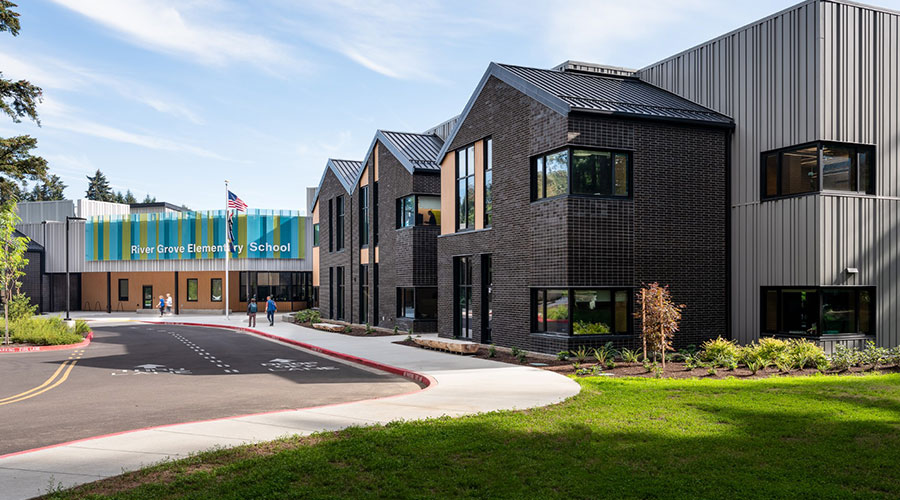
The result is a 79,500-square-foot, two-story elementary school serving 600 students from pre-kindergarten through fifth grade on a 10-acre site outside Portland. River Grove Elementary is fully electric and designed along a certified path to net-zero energy. More significantly, it is one of the first elementary schools in the United States to incorporate a microgrid system, placing it at the forefront of Oregon’s push toward zero-carbon energy production by 2040.
The project’s ambition extended beyond energy performance. From the beginning, the school district and design team were responding to two interconnected challenges — how to support student mental health while reconnecting school communities after the disruption of the pandemic and how to provide a facility that could serve as a reliable community resource during natural disasters.
Designing for climate and IEQ
For decades, architects in the Pacific Northwest relied on passive strategies, including daylighting, natural ventilation and thermal mass, to create comfortable, low-energy buildings. But as climate patterns shifted, those strategies alone proved insufficient. Increasing summer temperatures, prolonged smoke events and widespread power outages exposed the limits of conventional approaches.
In a region once defined by moderate conditions, smoke-filled skies, extreme heat and grid instability led to demands for buildings that could actively protect occupants while remaining operational during emergencies. River Grove Elementary was designed with this new baseline in mind.
One of the most consequential decisions on the project was a deliberate move away from fossil fuels. River Grove Elementary is designed along a certified path to net-zero energy, but the project’s ambition extended beyond meeting a numerical performance target.
The microgrid, developed through collaboration between the school district, the local utility provider, and Arcadis, a design, engineering and consulting firm, represents a shift in the way schools engage with energy systems. Rather than focusing solely on achieving net-zero energy within the building, the team prioritized carbon reduction at a grid scale. As a result, the school reduces its emissions and contributes to broader system resilience by stabilizing demand and supporting renewable energy integration.
The system integrates a large photovoltaic (PV) array, battery storage and backup generation, allowing the building to operate independently during grid outages while contributing to regional decarbonization goals. The microgrid also aligns the school with Oregon’s commitment to achieving zero-carbon energy production by 2040. In this context, it functions as an energy-efficient building and an active participant in the region’s evolving energy landscape.
Indoor environmental quality (IEQ) was another critical concern. Advanced ventilation and filtration systems were designed to maintain healthy indoor air during wildfire smoke events, while high-performance envelopes and mechanical systems address increasing cooling demands during extreme heat. Together, these strategies allow the building to remain a safe, functional learning environment even as outdoor conditions deteriorate.
River Grove Elementary was also designed as a Category IV seismic building — a classification typically reserved for essential facilities. This higher seismic importance factor allows the school to function as a shelter and emergency support center in the event of earthquakes or other disasters.
Backup power is provided through a combination of on-site generation, PV arrays and battery storage so the building can operate independently when the grid is down.
A school that supports
While climate resilience shaped many technical decisions in River Grove Elementary’s design, the social context of the project was equally influential. Designed during and after pandemic lockdowns, the school reflects a deliberate effort to rebuild student-teacher relationships and support mental health through the physical environment.
The design emphasizes daylight, clear wayfinding and visual connections to nature. Flexible learning spaces allow students to move between individual focus and group collaboration along with outdoor learning areas, which provide opportunities for instruction outside of the classroom. These spaces serve two purposes: supporting student well-being and offering alternatives when IEQ is compromised by smoke or heat.
Outdoor classrooms and learning terraces were intentionally integrated into the campus, reinforcing environmental awareness and stewardship at an early age. The school becomes a teaching tool for a generation growing up amid climate uncertainty, demonstrating the way buildings can respond responsibly to environmental challenges while supporting everyday learning.
Designing for resilience
Energy independence was only one aspect of a broader resilience strategy for River Grove Elementary. As a Category IV seismic facility, the school is designed to remain operational during and after major events to serve students and the surrounding community.
During power outages, the combination of on-site generation and battery storage ensures that critical systems can remain operational. The building can provide light, heating, cooling, refrigeration and communication capabilities when the surrounding infrastructure fails. These features allow the school to function as a stable refuge during emergencies, making it a community anchor with a critical role beyond daily instruction.
The building’s structural, mechanical and energy systems enable it to respond to multiple threats simultaneously, from seismic events to prolonged heat and poor air quality.
Balancing innovation and budgets
Early in design, cost estimates exceeded the available budget by about 10 percent. Instead of reducing program or performance goals, the team embraced a process of careful design problem-solving and responded by re-examining the building’s organization and footprint.
By condensing the overall footprint and reducing square footage dedicated to circulation, the team was able to decrease the building area by about 8 percent without compromising the quality of education. Classrooms and shared spaces remained intact, while efficiencies were found in layout, adjacencies and circulation design.
Cost discipline continued throughout the design process through regular estimates and careful evaluation of systems and materials. An early bid package allowed demolition of the existing school and initial site work to occur during the dry summer months, reducing weather-related delays and costs. This proactive approach paid off, and the school was delivered with one of the district’s lowest change-order rates — less than 3 percent.
A community asset
Besides serving students and staff, River Grove Elementary was conceived as a community resource. In emergencies, the school can provide shelter, power and essential services to neighboring residents — a resource that has become increasingly important as climate events intensify.
This function demonstrates a broader shift in public school design. No longer just facilities of instruction, schools like River Grove Elementary are increasingly expected to support community resilience, public safety and long-term environmental goals. Achieving that vision could not have been possible without the close collaboration among architects, engineers, district leaders, utility providers and the local community.
That partnership model proved essential to the project’s success. Decisions about energy systems, resilience strategies and community use were shaped through ongoing dialogue rather than isolated technical solutions.
River Grove Elementary offers a glimpse of the way future-ready educational facilities might look in regions grappling with climate change. By building on conventional passive strategies, embracing fully electric systems and integrating microgrid technology, the project has responded directly to a new environmental reality.
At the same time, its focus on student well-being, community support and fiscal responsibility reveals that resilience does not have to come at the expense of educational quality or budget discipline.
As communities nationwide face similar challenges, River Grove Elementary stands as a case study in the way thoughtful design, collaboration and long-term thinking can transform a neighborhood school into a resilient civic asset for an uncertain future.
Rebecca Stuecker is a principal at Arcadis, a design, engineering and architecture firm.
Related Topics: