 Photo credit: Westwood Professional Services
How Inclusive Playgrounds Can Shape More Equitable School District Policies
Inclusive playgrounds are often celebrated as visible symbols of equity, places where peers can swing, spin and explore side-by-side.
By Chad Kennedy, Contributing Writer
Key Takeaways:
- Inclusive playgrounds support students’ sensory, social and emotional needs, making play spaces an important part of a district’s broader learning environment.
- Treating accessibility and universal design as core infrastructure helps districts build inclusion into capital plans, project standards and budgets—not just individual playgrounds.
- Early community engagement, inclusive procurement and post-occupancy evaluations can make equity a measurable part of school planning and governance.
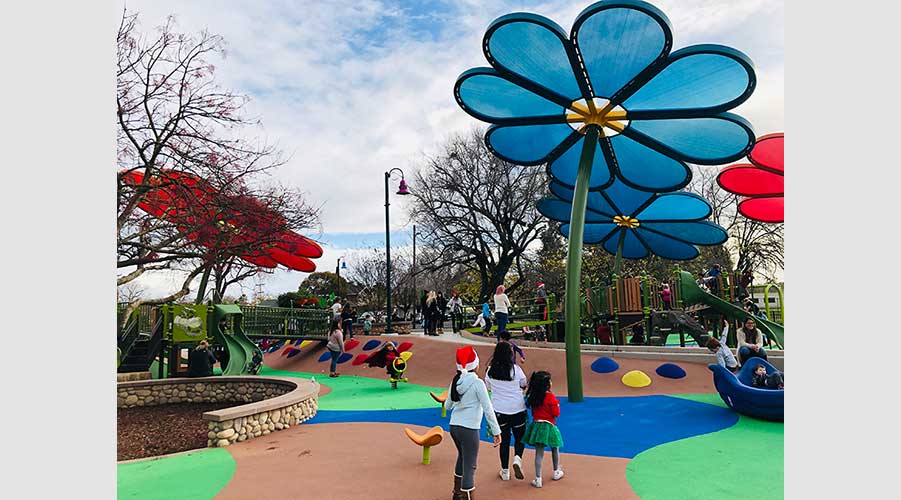
Inclusive playgrounds are often celebrated as visible symbols of equity, places where peers can swing, spin and explore side-by-side. Yet their greatest potential may lie beyond the play yard. When viewed not as isolated amenities but as prototypes for systemic change, inclusive playgrounds offer school districts a framework for embedding empathy, accessibility and belonging into capital planning, procurement standards and governance culture. The conversation, then, must move from equipment lists and surfacing materials to a broader question: how can lessons from inclusive play reshape policy decisions that guide school investment strategies?
Inclusion as strategy, not amenity
In many K-12 districts, outdoor spaces are treated as secondary to academic facilities, serving as places solely for students to release energy before returning to class. That perception minimizes the developmental role of play. Children learn to navigate social interaction, process sensory input and regulate emotion through active, self-directed play and exploration.
An inclusive playground begins with a recognition that children do not experience the world in the same way. Some are sensory-seeking, drawn to movement and sensory input; others are sensory-avoidant, easily overwhelmed by noise or visual complexity. A traditional playground with limited options, focused primarily on active play, may unintentionally exhaust some students, leaving them less able to focus when they return to class. By contrast, environments that incorporate cozy refuge spaces, loose parts, water and sand play and shaded green areas provide choice and self-regulation, aligning with the personal needs of a broader student body.
Seen through this lens, inclusion is not a specialty feature for a few. It is a design focus that anticipates diversity and builds flexibility into every decision, a mindset that can inform how districts write facility standards and evaluate future projects.
Funding inclusion as core infrastructure
One of the most persistent challenges is fragmented funding. When budgets tighten, inclusive features are often perceived as enhancements rather than essentials. Yet nearly one in five Americans live with a disability, and barriers in recreation spaces frequently exclude entire families from participation.
The policy opportunity lies in reframing inclusion as infrastructure. Just as districts would not treat fire safety or structural integrity as optional, accessibility and universal design can be codified as baseline requirements in capital improvement plans. Boards can require that all new and renovated projects demonstrate how they address diverse sensory, physical, cognitive and social needs, not as add-ons but as core performance criteria.
Inclusive design also aligns with outcomes districts already measure: student wellness, social-emotional development, attendance and community trust. Play environments that remove barriers become gathering places for everyone, even when users do not consciously recognize the design choices that make them welcoming. When inclusion is embedded into long-range facilities plans, funding conversations shift from “Can we afford this?” to “In what phase does this happen?”
Practical tools exist to support this shift. Thoughtful phasing strategies, disciplined value engineering and creative use of grade and natural elements can maintain diverse experiences while managing cost. Limiting fall heights to reduce the need for expensive impact surfacing, using compacted aggregate — in lieu of more expensive subgrade — beneath rubberized areas or partnering with philanthropically-minded local contractors and citizens, are examples of fiscally responsible inclusion. When codified in district standards, these approaches normalize inclusive thinking across all projects and decisions.
Formalizing engagement in policy
Another barrier lies not in the budget but in the process. Families of children with disabilities are often invited to provide input late in the design process, after key decisions have already been made. This pattern undermines trust and reduces the potential for meaningful innovation.
Inclusive playground planning demonstrates a more rigorous approach. Designers frequently conduct audits to evaluate the range and balance of experiences across physical, sensory, cognitive and social layers, and to adjust plans iteratively to ensure that no single category dominates. This back-and-forth process between space, budget and program creates intentional balance rather than accidental omission.
District leaders can translate this methodology into policy by formalizing requirements for inclusive engagement. Capital project guidelines can mandate early participation from families representing diverse abilities, cultures and socioeconomic status. Procurement documents can require design teams to demonstrate experience with universal design strategies. Post-occupancy evaluations can measure not only durability and cost performance but also user experience and accessibility. By embedding engagement expectations into governance frameworks, equity becomes a measurable standard rather than a hollow commitment.
Reframing the “special project” narrative
Inclusive playgrounds are sometimes misunderstood as amenities for a limited group of students. This framing diminishes their broader social value. Designs that remove barriers tend to improve usability for all. Accessible circulation routes for wheelchairs also support strollers and unstable grandparents/adults. Cozy refuge spaces are vital spaces for children with autism and benefit those coping with trauma, including experiences related to the COVID-19 pandemic and surges of refugees from all over the globe. The overlap between trauma-informed and inclusive design underscores a broader principle: environments that provide safety, choice and visibility foster resilience across the student population.
Green schoolyards further extend this benefit. Replacing overheated blacktops with vegetation and gardens not only supports sustainability goals but also creates outdoor classrooms that encourage comfortable sensory exploration and decision-making. When districts incorporate these strategies into sustainability policies and climate action plans, inclusion becomes part of environmental stewardship.
As accessibility standards have evolved — with playground requirements only formally incorporated into federal law in 2010 — many existing facilities fall short of contemporary expectations. Addressing that gap requires more than one exemplary project; it calls for systemic recalibration.
Scaling the blueprint
The balancing act between experience, space and budget that defines inclusive playground design mirrors the trade-offs districts face across entire campuses. If a small play space can provide diverse sensory and social opportunities through inventive use of grade and programming, then classrooms, libraries and community facilities can also embed flexibility and refuge. Urgency for inclusion can be amplified by shifting community expectations as families increasingly recognize that better options exist and expect districts to respond with environments that reflect dignity and belonging. Leaders who prioritize inclusion into board policy, design standards and capital planning demonstrate that equity is not occasional but permanent.
Inclusive playgrounds are powerful symbols. Yet there is also deep value in the governance lessons they offer. They highlight that empathy can be operationalized, that diversity can be anticipated rather than retrofitted and that fiscal responsibility and equity are not competing priorities. If districts can design play environments where every child belongs, they can write policies that ensure every future investment reflects that same conviction — transforming inclusion from a project-level aspiration into the organizing principles of educational systems and programs.
Chad Kennedy, CLARB, FASLA, CPSI, LEED BD+C, ISA Certified Arborist, is a Director with Westwood Professional Services. He can be reached at chad.kennedy@westwoodps.com or 888.937.5150.
Related Topics: