Can Facilities Managers Trust AI?
As artificial intelligence takes on a larger role in building operations, facilities managers must learn how to embrace its capabilities without giving up control. November 18, 2026
By Elaina Myers, Assistant Editor
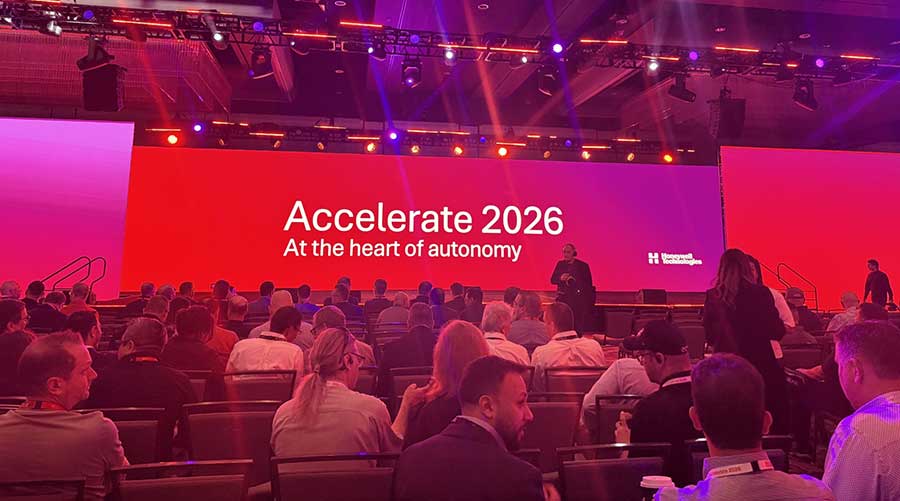
As I walked the Innovation Hub at the recent Honeywell Technologies Accelerate conference in Orlando, Florida, I was in awe at just how many facets of a building are now being automated. I was even more shocked at the role artificial intelligence (AI) plays in all of this. I knew AI was drastically changing the facilities management landscape but had no idea just how powerful it could be.
The technologies on display demonstrated just how close we are getting to truly autonomous buildings. Among the innovations introduced were an AI-powered building operations platform to help operators interpret alarms and pull building insights from operational data, and new fire detection technology designed to distinguish actual fire signatures from nuisance triggers like steam and dust. The company also introduced new carbon monoxide monitoring capabilities and an application to help emergency responders better understand building conditions.
There is no denying that these technologies have the potential to make facilities managers' jobs easier. But as I spoke with attendees and attended a group discussion with Ryan Casey, senior technical solution engineer at Cisco, one topic kept coming up: trust.
How much should managers trust AI? Can they fully understand what it is doing, and perhaps more importantly, can they trust it not to do something they never intended it to do?
There is a big difference between a system alerting a manager that an HVAC unit is underperforming, and a system making adjustments to building operations without human input. The more facilities departments rely on AI, the more important it becomes to understand its decision-making process.
AI utilization is not off in the distance for facilities. It is already here and its impact is only growing. But just because organizations are adopting AI, does not necessarily mean they trust it. McKinsey's 2026 AI Trust Maturity survey found that 74 percent of respondents considered AI inaccuracy a relevant risk, while 72 percent identified cybersecurity as a concern. The report also found that only about one-third of organizations had reached an established level of AI governance in areas such as oversight and controls.
The stakes are particularly high for managers if they receive a wrong recommendation or unintended adjustment, because life safety could be at risk. Managers cannot afford to simply assume that because a system is intelligent, it is always right.
So, how can facilities professionals implement AI without handing over too much control?
Managers should start by treating AI as an assistant. They should continue to double-check the information AI provides, particularly when critical building systems are involved. AI can help identify patterns and suggest solutions, but managers should still understand why a particular recommendation is being made before acting on it.
Just as importantly, facilities teams need to establish clear parameters. Not every decision needs to be autonomous. Defining operating limits and establishing when a human must intervene can help prevent technology from going beyond its intended purpose.
Accelerate showed the many exciting directions that building automation is headed, but the future of facilities management cannot be built on technology alone. It requires people who understand the tools they are using and know when to question them. AI may be able to help run a building, but managers still need to be the ones in control.
Elaina Myers is the assistant editor of the facilities market. She has covered various topics from pest management to resilience to sustainability and covers all holidays and special days in the facilities field. She also manages the FacilitiesNet social media accounts.
Next
Read next on FacilitiesNet