Emerging Technologies Redefine Backup Power Systems
BESS, microgrids and AI offer owners greater flexibility and reliability in their efforts to protect facilities operations.
By Dan Hounsell, Senior Editor
Commercial building emergency power is evolving rapidly. Driven by sustainability goals, regulatory pressure and the need for greater reliability in institutional and commercial facilities, modern systems incorporate traditional diesel generators and adopt cleaner, smarter and hybrid solutions. A growing number also are integrating artificial intelligence (AI)-powered management, renewable energy sources and remote monitoring to ensure continuous uptime for critical infrastructure in facilities.
All of these changes to backup power systems create a fluid landscape for building owners and facility executives whose plates already are full with a range of challenges from skyrocketing vacancy rates and the return to office movement to curtailing greenhouse gas emissions.
“There are increasing pressures put on building owners and facility managers and design managers related to budget, schedule and sustainability,” says Mark Woods, electrical technical manager with Henderson Engineers, a building systems design firm.
Changing priorities
While building owners in general are paying greater attention to emergency power systems, the changes are not uniform among facilities markets.
“Backup power in general tends to be market-segment driven,” says Stephen Estep, owner and senior electrical engineer with Smith Seckman Reid, a design, consulting and planning firm. “Projects like a data center or a hospital where there are critical ongoing operations that require backup power, that’s a little bit higher on the priority list versus a commercial building, multifamily or something like that where there’s still oftentimes code-required backup power needs.”
As climate change results in more frequent, powerful and costly natural disasters, interest is growing in many facilities in more robust backup power systems.
“In recent years, there has been an expansion of projects exploring backup power beyond just the code required items, as well as an increase in projects having sustainability goals and looking at things like carbon footprint that may drive some of their decisions,” Estep says.
Growing uncertainty about the impact of weather is prompting more owners to consider resilience efforts to ensure their facilities can successfully prepare for, respond to and return to operation quickly after a natural disaster or other emergency.
“They’re focusing on operational resiliency within their facility,” Woods says. “They may have a heightened awareness of the impact of operational downtime. An example I can think of was in 2017. We were just starting design on a project, and it was when the Atlanta Hartsfield Jackson Airport power outage occurred. That event gave the owner a very heightened awareness of the operational impacts of downtime on their facility. That project we had a very heightened focus on backup power throughout the design phase.”
The precarious condition of the nation’s electrical grid also is complicating the emergency power issue for owners.
“Obviously for most areas of the country, the electrical infrastructure is aging,” Estep says. “There tends to be an increase in the electrification of everything, as well as just an increase in extreme weather events, whether it’s hurricanes, tornadoes or wildfires. All of those things combined leads to some concerns with grid instability.”
Emerging technologies
For decades, facilities have relied on proven technologies to provide emergency power for facility systems and operations.
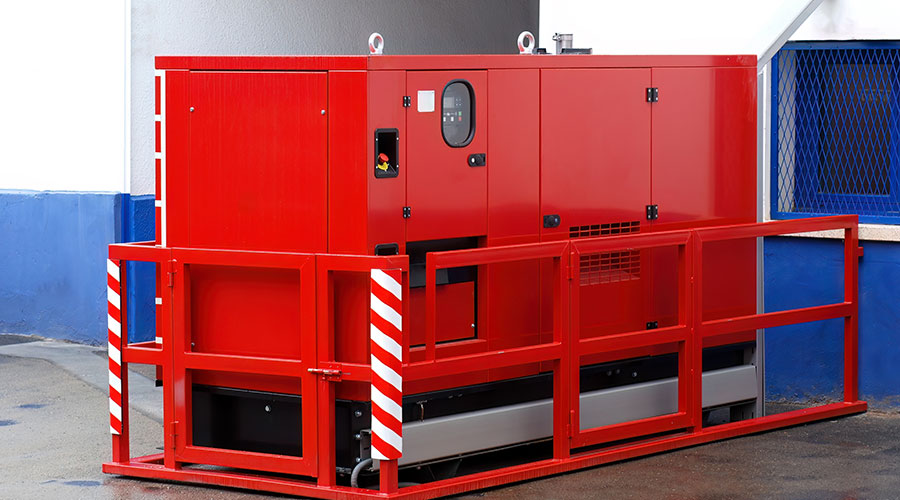
“Traditionally, most facilities that have backup power are using either natural gas or diesel generators with automatic transfer switches, as well as in some instances uninterruptible power supplies for things like their IT systems where they can’t survive that or they want to limit that the impacts of that transfer of power from utility to generator,” Estep says. “The big thing with those systems is that they’re only really there for the emergency power use. They’re only active during the loss of utility power.
“Ideally for most parts of the year, those systems are sitting there idle and not really utilized. What we’re seeing emerging technology-wise is integrating multiple technologies from obviously the traditional generators, as well as battery energy storage, photovoltaic systems and microgrid controllers to combine all those systems and control them as one.”
Battery energy storage system (BESS) technology is among the most prominent of the technologies gaining traction in facilities in recent years.
“Those can be either a standalone or part of a microgrid system,” Woods says. “The microgrid then would incorporate other distributed energy resources, such as photovoltaic panels, wind turbines, potentially hydrogen fuel cells and traditional diesel or natural gas gensets.”
One challenge for owners considering BESS technology for their facilities’ emergency power systems is understanding what it is — and is not.
“One thing that is a little bit of misnomenclature is the battery energy storage system is not a UPS, so it’s not uninterruptible power,” Estep says. “There still is a slight delay in the transfer of power. But we’re seeing those being entertained more as battery technologies and improve and battery costs come down. I fully expect us to see an increase of battery energy storage being part of emergency backup power systems.”
Among the technologies affecting emergency power systems in facilities is one tried-and-true system that is seeing a resurgence: natural gas generators.
“They’re not an emerging technology,” Woods says. “Those have been around for many years, but we do find that they’re more widely accepted across authorities having jurisdiction. Owners like them because they don’t require on-site fuel storage, which inherently gives them unlimited run time. They have a little higher first cost, but they have lower operating costs, and there are lower emissions, which helps with some of the sustainability pressures that they’re under.”
No discussion of facilities technology these days is complete without considering the role of AI, and emergency power systems are no exception.
“What I see AI currently being used for is in some predictive measures, whether it’s predictive maintenance or predictive load estimating,” Woods says. “They may have a system that will monitor the rest of the facility and through AI make predictions on where the load may be at a later point in time.
AI’s potential in these scenarios also enables owners and managers to more effectively analyze a range of issues affecting emergency power systems to make decisions that optimize operations.
“For these microgrid systems that do load management, there is certainly potential for there to be an AI aspect of how best to optimize that system given the current building loads, current grid condition, weather forecasts, utility cost, things like that,” Estep says. “There certainly could be AI integration as to how best does that system get optimized and continually optimized, not just set up once and that’s what it is until some technician comes and updates the programming.”
Putting it all together
Ensuring owners end up with effective and reliable emergency power systems for the facilities requires more than just understanding the technologies involved. Owners also need to consider several potential trouble spots in the process.
The first issue involves working with utilities.
“It’s important to work with the utility early on some of these projects because they have their own requirements,” Estep says. “As these systems become more common, their requirements are changing and updating during that process. The last thing you want to do is to get to witness testing with the utility and everything not be working out as it should in coordination with the utility. Early coordination with the utility is extremely important.”
A second ongoing issue for owners is understanding and clearly communicating the emergency power needs of their facilities.
“A lot of them have very good knowledge of what is required by code versus what is optionally required,” Woods says. “We generally understand what their needs are based on what the facility is, but we have to work with them to get an understanding of how they want the facility to operate during a power outage.
“The design team’s understanding of the operational needs of the owner based on the facility type is critical to the early stages of the design. Working with them early and the importance of them making themselves available to us early to get that information so then we can design the system that’ll perform the way that they desire is critical.”
Backup power system upgrades and installations are big-ticket projects, so government and utility incentives often are central to project financing. Estep says as a result, savvy owners need to keep a close eye on local and national politics when making long-term plans.
“With the ever-changing political landscapes, with incentives, with renewable technologies and things like that, attention needs to be paid to any incentives that a project is going after,” Estep says. “How do you ensure that you can maintain those incentives if the project’s design construction schedule spans multiple legislative sessions? If you’re relying on certain tax credits, how do you best maintain that tax credit even though the political landscape may change in the coming years?”
Dan Hounsell is senior editor for the facilities market. He has more than 30 years of experience writing about facilities maintenance, engineering and management.
Related Topics: