Makerspace Movement Gives Facility Managers Hiring Options
Maintenance and engineering departments can consider these workshops for finding prospective candidates.
By Joel Leonard, Contributing Writer
Surely, we do not have to inform facility managers that there is a serious challenge finding qualified skilled workers at institutional and commercial facilities. The labor shortage is so bad that a meme recently made the social media circles stating that the long-haired freaky people can now apply and get hired, satirizing the popular 1970s song “Signs” to express the enormity of the labor crisis.
Seriously, where can you find people who love to tinker, love to work with electronics, electrical, pneumatics, hydraulics, microcontrollers, raspberry pies, Arduinos, programmable logic controllers and love to make and fix stuff?
A major maker movement is underway and sadly most of our current engineering and maintenance departments are completely unaware of this major grassroots effort to get more to upcycle and make things.
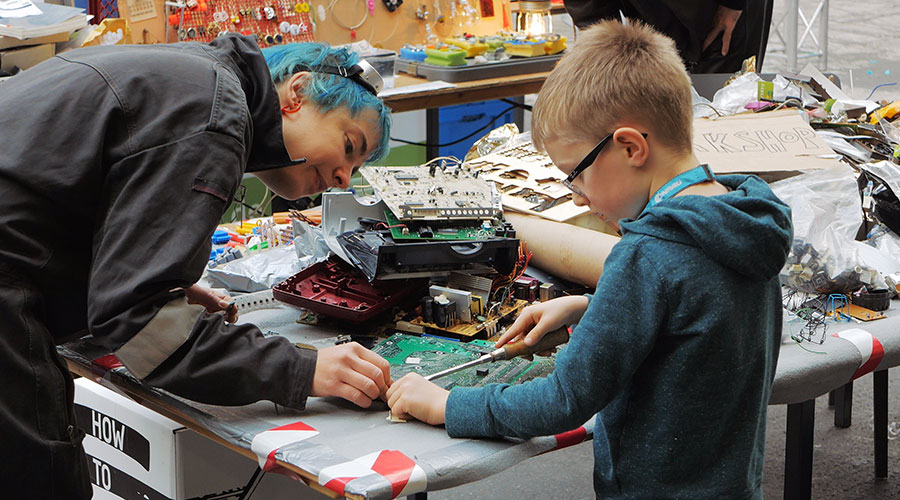
Makerspace, hackerspace, fablabs and tool libraries are just new words for community workshops and there are an estimated 3,000 of these all over the United States.
Various kinds of makerspaces are striving to backfill the retiring boomers and giving new generations access to tools, equipment, experiences, references, digital credentialing badges, industry certifications, perform prototypes and new product development and pathways to support manufacturing.
Makerspaces collect equipment and supplies that would be too expensive for most people to afford or have a place to store. The best contribution a makerspace creates is a maker community, where groups of people gather with the goal to make, fix, upcycle all kinds of items and most importantly help each other. Many of the new 3D printers were innovated at a makerspace site. These spaces provide room and access to difficult-to-locate talent. As opposed to a woodshop just making items out of wood, makerspaces often house not just woodshops but metal shops, electronic benches, textile centers, pottery kilns and much more depending on the space. This collective synergy enables makers to pull insight from a variety of perspectives.
How can managers benefit from the maker movement?
If you know how to make something, it makes it easier to fix it, right? That may not apply in all scenarios, but the skill sets and confidence gained in making does help grow many of the skills needed in reliability, facilities, manufacturing operations and maintenance.
Here are some suggested recommendations for companies to implement if you want to do more than just complain about the problem:
- Google makerspaces nearby and share with them job openings as opposed to buying a want ad which can be over $500 and attract many unqualified candidates.
- Visit makerfaires (celebrations of Making) to go and look around. Just by hanging out at makerspaces and watching people work, managers can evaluate talent much better than during an interview and truly know the type of worker you could be hiring.
- Do stealth recruiting, meaning do not announce that you are hiring and work on personal projects to get to know the members, then privately have more serious discussions with potential employees.
You can even use the makerspace equipment to prototype various new designs for new products or reengineer parts to replace or create new parts that are out of the supply chain. Many makerspaces are investing in CNC machines and offer training programs on popular industrial equipment. Many makerspaces love supporting robotic teams, that could help locate talent who are able to set up and maintain automation and IOT sensors.
Post pandemic, several groups around the country are setting up mobile makerspaces to help homeschoolers, rural and underserved communities achieve hands-on training in a sanitized safe environment.
Sponsoring a makerspace at just the cost of your normal advertisement of just $500 could earn you serious support for your goals to grow your workforce. Perhaps makerspaces could organize specific classes to help you and even host job fairs or help with interviews.
The maker movement can greatly help give your work a chance to overcome the skilled labor shortage by helping grow pipelines of skilled talent in your area. All we are saying is give work a chance!
Joel Leonard is a reliability, availability and maintainability (RAM) supporter for more than 30 years to build the next generation of technicians. He was recognized at the Nation of Makers as the biggest Maker Advocate in 2019. He grew the Association for Facilities Engineering, Society Manufacturing Engineering and chaired the National Defense Manufacturing committee and has served on several White House manufacturing advancement committees.
Related Topics: