 Photo credit: Chris Costea, courtesy LPA
 A K-12 Schools Lesson in LEED Platinum
Montgomery Middle School in California achieves great marks with its LEED Platinum model for sustainable schools.
By Ronnie Wendt, Contributing Writer
Key Takeaways:
- Montgomery Middle School demonstrates how addressing deferred maintenance can become an opportunity to create a high-performance, sustainable facility that reduces energy use, lowers operating costs and supports long-term educational goals.
- The project's success was driven by an integrated design approach that prioritized building orientation, daylighting, natural ventilation, a high-performance envelope and efficient mechanical systems to exceed energy standards and achieve LEED Platinum certification.
- Facility managers can apply lessons from the project by prioritizing long-term sustainability goals, fostering collaboration across project teams and improving existing building operations to capture energy savings without necessarily undertaking major capital projects.
Montgomery Middle School in Chula Vista, California, once offered a lesson no district wants to teach: Deferred maintenance always comes due.
But what began as a response to aging facilities, water damage and displaced classrooms ultimately became one of California’s most ambitious K-12 sustainability projects.
When Sweetwater Union High School District set out to replace deteriorating portions of the Montgomery Middle School campus, district leaders seized the opportunity to construct a high-performance learning environment that would reduce energy consumption, lower operating costs and demonstrate environmental stewardship for decades to come.
The resulting $22 million campus transformation earned LEED Platinum certification, exceeded California energy-efficiency standards by nearly 40%, and created a sustainability blueprint for other school districts to follow.
Today, Montgomery Middle School serves as a case study in how thoughtful design, integrated engineering, and strong leadership can turn a routine replacement project into a sustainability showcase. In February, attendees of the U.S. Green Building Council’s Green Schools Conference were given the opportunity to tour the school and see the district’s plan in action.
Committed to sustainability
Like many school districts across the country, the Sweetwater district faced growing facility challenges across its aging campuses. Outdated infrastructure, deferred maintenance, and changing educational needs drove the need for major upgrades.
Erik Ring, director of engineering and principal of mechanical engineering at LPA Design Studios, the project’s sustainable design architecture firm, shares that Montgomery Middle School was among several projects financed by a voter-approved bond measure to update district facilities.
“As with any school district, facility needs grow over time,” Ring says. “The Sweetwater Union High School District had several schools that needed renovation or repair.”
The approved funding allowed the district to update or completely replace aging facilities while adding modern classrooms, a library and media center, counseling services, food service facilities and collaborative learning spaces.
But at Montgomery Middle School, district leaders wanted to do more than replace an aging structure. They sought to build a facility that met students’ needs while lowering energy and maintenance costs.
A flagship project
While many projects funded through the district’s bond program targeted LEED Gold certification, facility management selected Montgomery Middle School for the LEED Platinum designation.
“They asked us to design a flagship school as part of the bond program,” Ring says. “The goal was to achieve a rating higher than LEED Gold, the benchmark set for their other initiatives.”
He adds that achieving LEED Platinum certification is far more challenging. It demands a coordinated effort among owners, designers, contractors and facility stakeholders from project inception through completion.
“Attaining LEED Platinum requires a commitment to every detail,” Ring explains. “You have to protect the features and systems that contribute to certification and resist the temptation to value engineer them out of the project.”
Let the building design to the work
While mechanical systems can reduce energy use, Ring says LPA’s design team focused on making the building itself work harder.
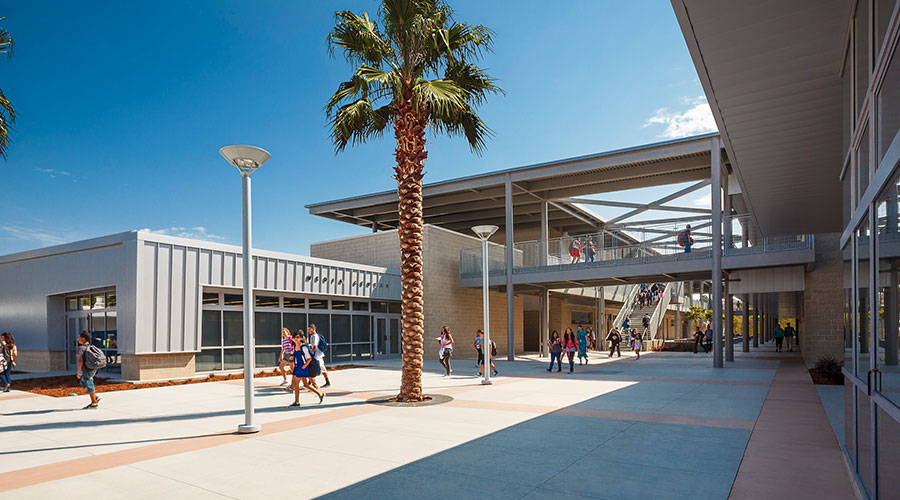
That started with positioning the two-story structure in a way that maximized daylight but minimized unwanted solar heat gain. LPA designed every classroom with access to the outdoors on two sides, which allowed natural light and ventilation to play a larger role in occupant comfort.
“We purposefully designed the building with single-loaded corridors, so every classroom is open to the exterior on two sides instead of one,” Ring explains. “That allows for daylighting and operable windows on opposing sides of the classroom, which improves natural ventilation and access to daylight and reduced reliance on mechanical systems.”
Optimize the building envelope
The design of the building envelope also played a key role in reducing heating and cooling loads, according to Ring.
The project utilized concrete masonry block construction, which enhanced durability, controlled energy costs and boosted thermal performance.
“When you use masonry block in Southern California, the block is fully grouted to meet seismic requirements, which creates thermal mass,” Ring says. “This thermal mass helps moderate indoor temperature fluctuations, improves energy performance and contributes to a more efficient building overall.”
Other building envelope improvements included high-performance glazing, enhanced insulation and carefully designed shading systems.
“A large overhanging roof helps control solar heat gain while giving the building its distinctive appearance,” Ring says. “South-facing windows benefit from integrated shading, while north-facing glazing lets in abundant daylight without excessive heat gain.”
The design team also exceeded code requirements for roof insulation, he adds.
“We made design decisions like that and went well beyond code requirements to optimize the building envelope,” Ring says.
High-performance systems
While the high-performance building envelope reduced overall HVAC demands, Ring says they also designed these mechanical systems for efficiency.
One of the most innovative features was a thermal displacement ventilation system. Unlike conventional systems that supply conditioned air from ceiling vents, displacement ventilation introduces conditioned air at lower velocities at floor level. As occupants and equipment generate heat, the warmer air rises naturally and is exhausted from the space.
This approach improves ventilation and reduces fan energy demand.
Additional energy-saving systems include efficient lighting controls, daylight-responsive dimming, low-flow plumbing fixtures, indoor air quality monitoring and classroom carbon dioxide sensors that adjust ventilation rates based on occupancy.
According to Ring, all of these improvements work together to boost building performance.
“These measures add up,” he says. “Each one incrementally improves the energy performance of the building by a few percentage points that add up to a much more energy-efficient building than we would have had otherwise.”
Pursue net-zero
During design, the team explored making Montgomery Middle School a net-zero-energy facility, which is a building designed to generate enough renewable energy on-site to offset its annual energy consumption.
“In 2010-2011, when we started, designing for net-zero was very rare,” Ring says.
Though it wasn’t mainstream at the time, the project team approached net-zero through solar generation as a design driver rather than an afterthought. The team designed the building’s orientation, roof geometry and south-facing sloped roof to support a large photovoltaic installation to help the campus move toward net-zero energy performance.
However, changes in district-wide solar planning altered the outcome, he notes.
Ring explains that, at the time, photovoltaic systems were more expensive than they are today. As a result, the district chose to pursue a larger solar strategy through a power purchase agreement (PPA) that would serve multiple campuses.
Thus, Montgomery Middle School was built to accommodate solar energy, but the photovoltaic system was never installed. However, the building remains solar-ready should the school want to pursue it someday, Ring adds.
Lessons learned
Montgomery Middle School offers valuable insights for facility managers undertaking comparable modernization initiatives.
First, commitment from the top-down matters.
“The district’s commitment to LEED certification and grater sustainability was critical,” Ring says. “Without clear direction from ownership, sustainability initiatives often become vulnerable to cost-cutting measures during design and construction.”
Second, successful high-performance buildings require integrated planning.
By bringing architecture, engineering, interiors and landscape architecture together under one umbrella, they were able to align sustainability goals across disciplines.
Third, energy efficiency does not always require major capital projects. Many school districts can achieve substantial savings when they improve existing operations
“Many schools run pretty lean on maintenance,” Ring says. “But they still can make changes to be more sustainable and use less energy.”
He explains that a thorough review of building systems can reveal opportunities to correct maintenance scheduling issues, repair malfunctioning controls, replace outdated equipment and cut unnecessary energy consumption.
“Fixing what’s not operating optimally is often the most cost-effective thing that a school district can do,” Ring says.
A lasting example
It’s been over a decade since Montgomery Middle School opened, but the school still highlights the benefits of sustainability initiatives.
Besides reducing the facility’s energy consumption and operating costs, the project created a healthier learning environment, improved indoor air quality and strengthened community confidence in district investments.
This project reminds other facility managers battling aging infrastructure and rising costs, that the most successful buildings are those designed for future efficiency.
The Montgomery Middle School project began as a solution to deferred maintenance. It now is flagship model for how thoughtful planning, sustainable design and long-term stewardship can transform a capital project into a lasting community asset.
Ronnie Wendt is the owner of In Good Company Communications and a freelance writer specializing in articles for the facilities management, aviation, RV and automotive, meetings and events, security, logistics and business technology industries.
Related Topics: