Tampa International Airport Designs with Safety and Sustainability in Mind
Tampa International Airport earns LEED Platinum certification through multiple sustainable projects.
By Maura Keller, Contributing Writer
OTHER PARTS OF THIS ARTICLEPt. 1: This Page
When it comes to well-established resiliency and sustainability design initiatives, the Tampa International Airport sets a high bar. Designed by safety, sustainability, and efficiency, the airport’s master plan and sustainable management plan maintain a high safety and environmental standard for all aspects of the airport’s design – from roadways to buildings to airfield operations, all within a regional context.
Eric Caplan, sustainability and resilience program director at Tampa International Airport, says the airport has always been an innovator and well-regarded in the space of airport planning and development, among many others. This is deeply rooted in the community, as Tampa Bay is the location of the very first commercial flight, led by pilot Tony Jannus. The airport was also home to the world’s very first automated people mover train at an airport, which was implemented in the early 1970s and served as inspiration by the trains developed by Disney.
“In addition to the world’s first automated people mover, the airport also incorporated some elements of airport design that we are now famous for, including the hub and spoke design with a main terminal and airsides, as well as the blue and red lanes, designed to continually decongest passenger traffic,” Caplan says. “This innovation continued to develop and evolve over the decades, up to the start of our three-phase master plan in 2011.”
The airport started formally looking at sustainable design around this time and ultimately received an Envision Verified Award for its master plan – phase 1 projects, which concluded in 2019 and included a new rental car center, SkyConnect people mover train, and expansion of the main terminal.
As the sustainability program formally took shape in 2014 and continued to grow, the airport turned to other sustainable design measures for phase 2 of its master plan, including the LEED Platinum SkyCenter One office building.
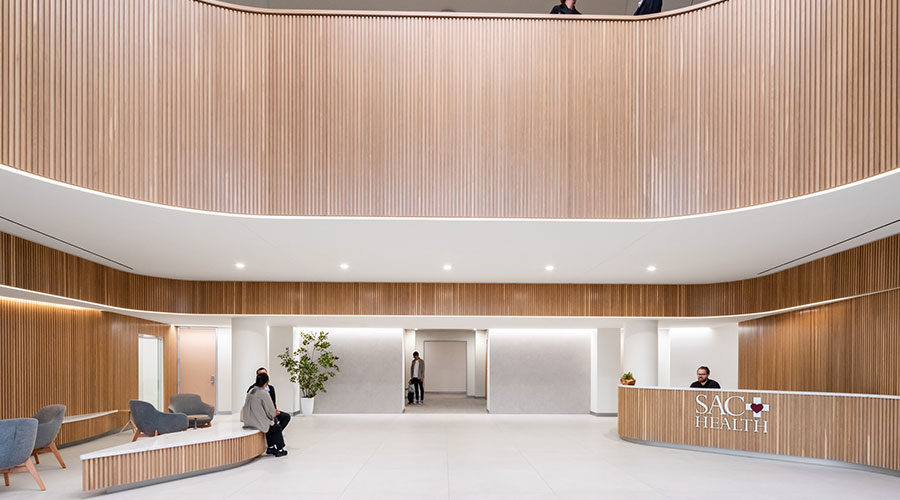
The largest component of the Hillsborough County Aviation Authority’s phase two is the development of the SkyCenter complex, Caplan says. SkyCenter One officially opened to the aviation authority staff in the spring of 2022, and is a 270,000-square-foot, nine-story office building, located on the southeastern corner of the airport’s property. SkyCenter One is connected to the airport’s new rental car facility by an elevated pedestrian bridge, from where building occupants can reach the main terminal via an electric train car in less than five minutes.
The SkyCenter One building now serves as the home office for almost half of the airport staff, as well as other companies who are leasing office space. Additionally, the SkyCenter complex includes a 40,000-square-foot atrium building, a 230-foot-long pedestrian bridge connecting to the SkyConnect station at the rental car center, a new 650-foot commercial curbside, a 230-foot extension of the rental car center’s remote curb that serves Hillsborough, Pasco and Pinellas County buses, and the reconfiguration of the cell phone waiting lot including new restrooms and flight information display system.
SkyCenter one was developed with a high focus on sustainability, achieving LEED Platinum certification for its core and shell, which is the highest rating given by the U.S. Green Building Council.
As Caplan explains, the sustainability benefits included in the SkyCenter One building include 66 electric vehicle stations, 100 percent low-emitting electricity materials and energy efficient appliances translating to a 34 percent reduction in energy savings, a 38 percent reduction in water consumption throughout its facilities, the use of 100 percent graywater for irrigation, the use of 40 percent recycled content materials for construction, and the redevelopment of an officially designated brownfield site, among many more. The three floors that host almost half of the airport staff also achieved LEED Gold criteria.
“As far as wellness design, SkyCenter One includes base-building amenities such as a state-of-the-art fitness center, conference center and building café on the ground floor,” Caplan says. The three floors that make up aviation authority staff include centralized printing and waste disposal areas, social hubs to promote internal connectivity, shared workspaces, circulating stairs to promote employee movement, and a rooftop terrace on the fifth floor where employees can work, socialize, and engage as an extension of the indoor workspaces.
Phase 2 also included the development of a new water and energy efficient central utility plant, as well as the blue and red express curbside lanes, which continues to decongest passenger traffic and idling time, Caplan says. Phase 2 was officially completed in the fall of 2025 with the red express curbside lanes opening to the public, all while the airport focused on completing the design-phase of the third phase of its master plan project, a new international terminal called Airside D.
“The 16-gate Airside D will be modern, world-class and innovative, and is also pursuing a LEED certification. It is set to be completed and open to the public in 2028,” Caplan says.
Key design standards
The airport’s innovative design standards have garnered plenty of attention. In 2025, the airport completed its first update to its Sustainable Design Criteria Manual, which includes design and construction considerations related to energy efficiency, water efficiency, waste reduction and resilience initiatives.
Developed by the aviation authority, this is an updated version from the original, which was created in 2014, and has a hyper-focus on energy resilience and storm protection considerations, in addition to traditional sustainability focuses. The manual provides practical guidance for contractors and designers to incorporate key strategies that optimize the environmental performance and long-term economic value of any renovation projects, new construction or other development projects at the airport.
The aviation authority has a longstanding commitment to sustainability and was one of the early adopters of a formal sustainability program throughout the aviation industry.The aviation authority began its sustainability efforts in the late 2000s, by creating initiatives such as transitioning all irrigation systems to reclaimed water and developing the internal sustainability manual. Over the past 10 years, aviation authority has further showcased this commitment to sustainability by incorporating electric vehicles into the fleet, implementing energy and water efficiency measures throughout buildings, installing a 2 megawatt solar array above the economy parking garage, adding electric buses, and focusing on third-party sustainable infrastructure certifications for some of the airport’s major master plan projects.
“Due to the formal adoption of the airport’s sustainability manual and update, this has led the airport to take a holistic approach in innovative, sustainable and resilience building design,” Caplan says. “Our capital improvement program includes the review, and when reasonable, incorporation of the recommended standards in the sustainability manual. For our larger master plan projects, the airport has leaned on third-party ratings systems such as Envision and LEED to encourage sustainable and innovative design.”
Indeed, the airport’s LEED certification works in conjunction with the well-established, strict building design standards. As Caplan explains, the state of Florida, as well as the airport, has some of the country’s strongest building design standards. However, the achievement of certifications such as LEED allows the airport to go over and above these required standards.
“For example, SkyCenter One was officially completed and achieved LEED-Platinum (core+shell) in 2022, and incorporated measures such as 100 percent stormwater capture and recycle construction material, in addition to energy, water, waste, and many other initiatives,” Caplan says.
The airport has embraced a holistic approach to its innovative building design and overall operations. The aviation association’s 2024 Sustainable Management Plan includes a goal of 100 percent compliance for the master plan and capital improvement projects with the sustainability and resilience criteria outline in the sustainability manual.
Embracing challenges
The addition of the airport’s sustainability manual, as well as standards inspired by certifications like LEED, to the airport’s already strict design standards, can elevate costs and impact project schedules.
“This is why the airport does not require these standards for every project on campus,” Caplan says. “However, when a project is relevant, or a major master plan project is applicable, addressing these additional standards are a value and commitment by the airport.”
Looking ahead, Caplan believes the updated 2025 sustainability manual showcases the airport’s continued commitment to sustainable and resilient design.
“Additionally, we continue to tweak our processes, as well as continue to complete planning efforts related to sustainability and resilience, which in turn inspires continued incorporation into development,” Caplan says. “The sustainability and resilience initiatives we are considering and incorporating into Airside D is also testament to this continued value.”
Maura Keller is a freelance writer based in Plymouth, Minnesota.
Related Topics: