Supplier Perspectives
Design and Style Convene at the Greater Columbus Convention Center
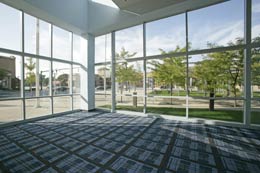 One of the more popular convention centers in North America, the Greater Columbus (Ohio) Convention Center, is celebrated by hospitality professionals and has been awarded the hospitality industry’s prestigious Prime Site and Inner Circle awards several times. Faced with an extensive expansion project in 1995, the convention center’s facility managers sought to maintain the complex’s original design elements. As a result of the creativity and cutting-edge technology used during the renovation, the facility continues to receive praise from the hospitality industry and draw thousands of visitors each year.
Since opening its doors in 1993, the Greater Columbus Convention Center has hosted thousands of events such as Arnold Schwarzenegger’s Fitness Weekend, the largest fitness event in the world. But the facility’s popularity came with a price — within two years, an $81 million dollar expansion was planned for the 1.5 million square foot convention center to add meeting and banquet room space.
Early in the planning phase, facility managers identified the need for design consistency in the new space. Guests needed to know they were in the convention center, no matter where they were in the complex.
Karlsberger Companies, a national planning and architectural firm, and TVS Ohio, an international interior design firm, were selected as the design team. Peter Eisenmann, the original architect, served as a project consultant. The team set out to incorporate the current interior design and exterior architectural elements into the new space, as well as the existing décor’s color palette.
The original carpet and the architectural design of the facility were used as an inspiration to create the colors and design in the facility’s new carpet. The carpet’s color, texture and pattern were integral to creating the cohesiveness desired by the facility managers. The carpet also had to be durable, due to the immense traffic through the complex.
Carpet constructed of Antron® Legacy nylon was selected. The end result was an 18x36 repeated custom design, utilizing multi-tuft and tri-ax technologies to create a sculpted, three-dimensional carpet texture highlighted by six colors: blue, green, gold, orange, gray and rose.
“Our guests have been very positive regarding the overall appearance of the facility,” states Art McAndrew, assistant general manager. “We have an aggressive maintenance program in place to maintain the carpet’s appearance. A number of cleaning methods, including hot water extraction, are utilized to maintain the carpet.”
The expansion, completed in February 2001, provides the continuity needed for guests within the convention center, while retaining its beauty and distinctive modern flavor.
Antron® is a registered trademark of INVISTA.
Powered Compact Storage a Solution for Many Facilities
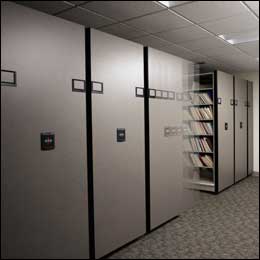 |
| The Eclipse Powered System™ sets a new standard in high-density mobile storage, due to its flexible design, simplicity and safety, making powered storage easier and more affordable. |
Storage is a critical issue for facility managers today and with good reason: it impacts the physical plant and operating budgets of virtually every commercial and industrial operation. To address myriad storage challenges, a growing number of decision-makers are looking to the latest innovations in compact mobile storage. Specifically, they’re moving beyond traditional solutions, and specifying and purchasing powered compact storage systems.
Compact storage systems
Compact storage, also called high-density mobile storage, is a widely accepted way to maximize capacity for storing and filing materials. Traditional systems that have found their way into many operations over the years include mechanical (or mechanical-assist) and manual systems.
A mechanical system incorporates a handle mechanism, such as a turning wheel, to make the carriage movement easier. Mechanical systems typically are used for moderate loads and short to moderate carriage lengths.
A manual system, understandably, is hand-operated (i.e. the user moves the shelving carriage by pushing or pulling it) and glides with near-frictionless carriage tracking for smooth movement. A manual system typically is used in smaller spaces and for lighter loads.
Over time, storage system manufacturers began to incorporate automation and computer logic technology into compact storage systems. The most advanced systems today are powered. Simply put, a powered system is a compact storage unit that operates by electricity with the touch of a button.
Inherent advantages of power
Manual and mechanical systems have their place in a variety of applications (for example, in non-public areas and where access is not frequently needed.) Yet powered systems offer a host of distinct advantages that make them an optimal choice for many facilities. Among these advantages are:
- Easy to use. Powered storage controls are designed to be as easy to use as riding in an elevator. In addition, powered systems are far more ergonomically friendly than manual or mechanical systems. For example, users turning a manual crank often each day may develop repetitive stress conditions.
- Productive. Powered systems allow fast access to materials and documents, making personnel more productive and efficient. Employees or users are able to enter an aisle while it is opening versus having to manually crank an aisle open before entering. This results in time savings and increased productivity over the long haul. In addition, an aisle that is used often can be set to remain open at all times.
- Secure. When compared with manual or mechanical systems, powered storage takes security to another level. Archives and valuable items can be protected from damage by electronically linking the system controls to a facility’s fire alarm, sprinkler, or security system. Environmental sensors can be added to enhance asset protection. The controlled movement also provides for ultimate collection care.
- Accessible. Storage systems installed in public buildings in the U.S. must meet the requirements of the Americans with Disabilities Act. Powered systems provide easier access for all users, with features such as push-button entry, adjustable aisle-width openings and automatic, passive aisle-locking features.
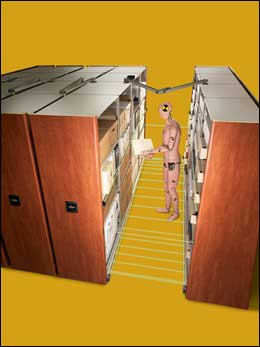 |
| Built-in redundant safeguards help prevent users from getting trapped or injured by the moving system. Many passive and active standard safety features are available on the Eclipse Powered System. |
Recent developments have made powered systems an even more attractive option for many applications. As an example, Spacesaver has re-engineered its powered storage product offering with the Eclipse Powered System™. The Eclipse system’s features and options represent a departure from previous powered storage products.
- Safety is a key benefit of the Eclipse system. Unlike manual or mechanical systems, the “human factor” is eliminated with powered systems. The result is more control over safety than with non-powered systems. Built-in redundant safeguards help prevent users from getting trapped or injured by the moving system. Many passive and active standard safety features are available.
- Reliability also has been greatly improved with the Eclipse system. The Eclipse system has fewer moving parts than earlier powered storage products, as well as non-contact limit switches and no-touch circuit boards to maximize reliability. It also can be equipped with an optional battery backup that automatically maintains full system functionality in the event of a power outage.
The Eclipse system’s menu-based configurability is a dramatic change that allows decision-makers to choose features and options on an “a la carte” basis to build the system they need. Its modular design also allows the flexibility for future upgrades.
The ability to choose only those features specific to the application also makes an Eclipse system more affordable, especially for institutions on tight budgets. Powered systems today may even be more economical than mechanical systems with similar safety and security features.
Powered storage systems, including the innovative Eclipse Powered System, allow facility decision-makers to address vital storage issues, utilize the latest technology and improve productivity.
For more information, call 800-492-3434 or visit www.spacesaver.com.
10 Tips for Selecting a Security Systems Integrator
By Tom Giannini, CPP
Director, Integrated Security Systems
SimplexGrinnell
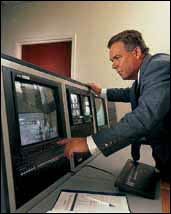 Let’s face it. Whether you're managing a hospital campus or an office tower, a manufacturing facility or a retail mall complex, your security risks are higher today than they’ve ever been. In an effort to strengthen and improve their security programs, companies and institutions throughout North America are looking to install a first-time electronic security system or to upgrade an existing system. We’re also seeing an increasing number of enterprise solutions, where multiple sites and systems are linked together so that an entire security environment can be managed from a single point of control.
The selection of a systems integrator is critical. As a key player in security operations/management, you want to make the right choice. Your security systems integrator must be a business partner – a security specialist who will protect your investment by using technology correctly and helping meet future needs with cost-effective maintenance and upgrades. Given the short- and long-term implications, it’s vitally important that you make a good decision about who your provider will be. Here are 10 suggestions for getting it right.
1). Use a due-diligence process.
Due diligence is a business process that will help you select a security systems integrator with the experience and personnel to get you up and running now – and with the staying power to be on hand to service and upgrade your system over the long term. This will enhance the protection of your facilities, operations and people, and also preserve your investment as the organization’s requirements evolve over time. Today’s systems are technology driven and constantly evolving, making it almost impossible for security directors and other security operations personnel to keep abreast of the latest trends. There’s a lot of money involved in an electronic security system. It ends up being a business decision that can’t quickly be reversed. The due-diligence process is your assurance of partnering with the integrator that can best meet your needs.
2). Do some initial homework.
You will need to do some up-front work and analysis before beginning the due-diligence process. It’s important to understand your past security needs, your present needs, and your future requirements. Interviews with key personnel and managers in your organization will help you understand their individual needs, and by extension, your organization’s overall security requirements. You should make an effort to educate all personnel on the benefits of adding an electronic security system, or improving or expanding your existing system.
3). Assess your vulnerabilities, and apply risk analysis to your security operations.
This phase of the process should include a risk assessment where you identify security-related risks, from both internal and external sources, to your facilities, assets and personnel. You need to know what kinds of business interruptions are acceptable, and which ones you simply can’t afford to take.
4). Make business continuity a priority.
You should have a plan in place that is designed to preserve your business operations in the event of a catastrophic event. You want to do everything possible to help maintain your critical processes and operations and your ability to serve customers. Disaster recovery is key to ensuring that mission-critical business processes continue unabated. Your security systems integrator should conduct an interview with appropriate personnel to learn your business continuity strategy and priorities. This information will provide guidance regarding the electronic security systems solutions that should be developed.
5). Consider emergency preparedness and evacuation.
You should develop an evacuation plan, and communicate it throughout your organization. In today’s environment, a voice evacuation system or mass notification system can provide critical communications capabilities to respond effectively to an emergency. Should a mass evacuation be necessary, you should have outside gathering points for people in your organization. You should also have processes in place to account for your personnel, so that this information can be communicated to emergency services without delay.
6). Develop an integrated security plan.
To implement the due-diligence process, you need a plan that includes a description of the issues to be solved, a list of those who have a vested interest in system implementation, and an overview of who will be responsible for the system. The plan should include a scope of work and system specification.
7). Develop a list of qualities you’re looking for in a security systems integrator.
First, determine how long the integrator has been in business: a minimum of five years should be the standard. Get financial and annual reports on the integrators you are considering. Learn about their organizational structure, core competencies, installation and service delivery capabilities, and the overall level of expertise in integrated security.
8). Assemble customer contact information, and arrange client visits if possible.
When visiting a customer, talk to security management personnel, system operators, and system administrators. Find out if they’re satisfied with the systems integrator. Determine the level and responsiveness of customer support, and the quality of maintenance. In other words, get as much relevant third-party input as you can.
9.) Prepare a list of requirements you want your security system integrator to meet.
Ask what system platforms the integrator installs and services, and how many trained technical staff there are in the organization. Find out if the integrator has employees who are Microsoft certified software specialists, CISCO certified networking specialists, and Certified Protection Professionals (CPPs). Ask the integrator how many other clients have a system similar to the one you that will be installed at your site. The answers to these questions will help you determine the integrator’s strength and ability to support you.
10.) Don’t be bashful.
Ask the integrator for training records, such as product training certificates, and inquire if the integrator provides recurring training for its personnel. And don’t just limit yourself to meeting with sales personnel. You should also interview management representatives and technicians as part of the proposal process. Probe your candidates for anything else you can think of that will help with your choice of a systems integrator. If your organization has other sites that may be looking to install or upgrade a security system, check out whether the systems integrator has offices around the country with security system installation and maintenance capabilities. The bottom line is this: You are the customer, so be demanding. In the final analysis, a quality integrator is one who will meet or exceed your expectations.
For more information, contact Chris Woodcock, SimplexGrinnell, (978-731-7052); chwoodcock@tycoint.com
NIKE Just Does it…Ceiling Recycling, That is
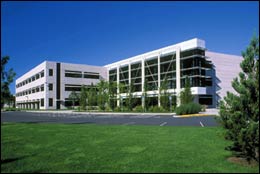 When it comes to recycling construction waste, Nike Inc. just does it.
As a result of continuing company growth, Nike recently decided to lease a 105,000-square-foot, three-story office building near its corporate campus in Beaverton, Ore. The building, which will house 380 employees, was only five years old, but as Jim Petsche, director of corporate facilities, notes, “The interior was originally designed for use by a computer company, which just didn’t work for us.”
Consequently, the company decided to renovate the building in order to create
an interior that had the same look and feel as the interiors of other facilities on the Nike campus. As part of the project, square lay-in ceiling tiles were replaced with new tegular tiles. However, instead of dumping the discarded tiles in local landfills, Nike decided to recycle them as part of the Armstrong Ceiling Recycling Program.
Program Offers Alternative to Landfill Disposal
The program enables building owners to ship old ceiling tiles from renovation projects to an Armstrong plant as an alternative to landfill disposal. Under the program, the company even pays freight costs for shipping the old ceilings (30,000 square foot minimum), which it uses as raw materials in the manufacture of new ceilings.
The discarded tiles from Nike were shipped to the Armstrong plant in St. Helens, Oregon, which is the destination point for all ceiling tiles collected on the west coast.
Since it introduced the program in 1999, Armstrong has reclaimed more than 30,000,000 square feet, or nearly 10,500 tons, of discarded ceiling tiles. The old tiles do not have to be Armstrong products to qualify for the program.
According to Petsche, Nike recycles as much construction waste as possible, including drywall, metal, wood and concrete. “Environmental consciousness guides all aspects of our business, including facilities. We’ve recycled ceiling tiles before,” he adds,” but never to this extent.”
Even though this ceiling recycling project was much larger than previous ones, Petsche reports there were no problems. “The process worked painlessly, and we’ll recycle ceilings again, especially since it fits so well with our commitment to implement green design and environmentally friendly practices whenever possible.”
These documents are not created or selected by FacilitiesNet’s editorial staff. They are provided by advertisers who sponsor this area of FacilitiesNet.