Lessons On Lifts
Managers speak from experience on finding the ‘right’ lift equipment
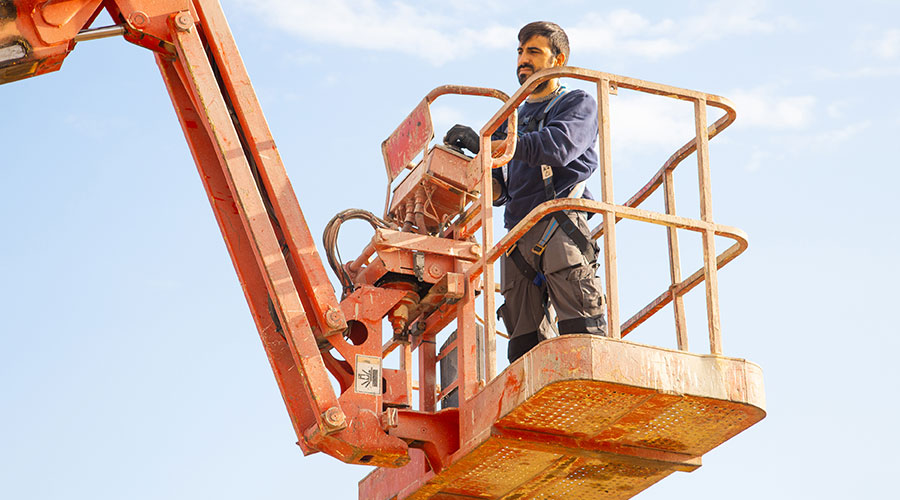
Some tools enhance productivity but probably aren’t necessary. But other tools enhance productivity and are absolutely essential. Among this latter group are personnel and equipment lifts. For most facilities, working safely and efficiently 20 feet in the air just can’t be accomplished any other way.
Working effectively with lifts requires that maintenance and engineering managers specify a lift that meets department needs. Determining the type and size of lifts takes serious thought about important characteristics, as well as about the way in which the lifts will be used.
One of the most important characteristics of a lift is mobility. If workers can’t get the lift to the job site, its extension height or safety features and even its cost mean nothing. Maintenance professionals who work with lifts suggest a number of considerations.
The Massachusetts Institute of Technology (MIT) in Boston owns many different types of lifts. But one of the first things that Steve Miskowski, MIT’s manager of operations, administration and planning, wants to know is whether it fits through a standard-sized door. It’s not that every lift has to, but a well-prepared maintenance department has to know it has enough lifts that will go anywhere at anytime, he says.
“Probably, the most important thing is to size them properly,” Miskowski says.
Chet DeFurio, manager of renovation services in the office of the physical plant at Pennsylvania State University in State College, Penn., says he makes sure his small equipment lifts fit into elevators and can quickly be loaded onto pickups using a gate lift. DeFurio says it is not only the size of the unit but its weight that is important to consider.
Also, the weight limit of equipment and personnel lifts can be critical. Departments with just a few lifts use them for everything, and maximum weight limits are important, he says.
Mobility extends to the platforms, as well, says Jim Harmon, electrical supervisor at the Anaheim (Calif.) Convention Center. Platforms with roll-out extensions save time and trouble of having to nudge the lift forward after the user has secured it.
Mobility also means maneuverability, Harmon says. Lifts are heavy pieces of equipment, and moving them quickly and safely over carpeting sometimes requires a great deal of effort and time. He makes sure that some lifts are self-propelled units. He also has had units customized to include a slip-clutch, differential-like mechanism so wheels can move independently of each other. This feature has solved the problem of maneuvering the lift on carpet.
“When we moved a standard lift, the wheels dragged and pulled carpet tiles up when we turned it,” Harmon says. “This customized one avoids that problem and the problem of having to replace tiles.”
Steady as She Goes
Because lifts suspend personnel and equipment in the air, stability is an essential issue to consider during specification.
DeFurio often uses manual cable lifts to maneuver equipment such as fan-coil units and air handlers into place. Stability when lifting heavy equipment is critical.
“Typically, there will be a group working around the unit, and we want to make sure the lift and equipment is as stable as can be,” he says.
“We look for lifts that, when they are extended, they have a good support system for the unit,” Miskowski says. “If they have outriggers, we make sure that they can extend far enough and that they are easy to extend. Also, with outriggers, we look to see if they are attached or have to be manually attached. If they’re attached, I think the staff is more likely to extend them, even if it’s just a quick job.”
Safety
Stability is one area that manufacturers have concentrated on in recent years. But even with these features, managers and users must keep other issues in mind. For example, it is important to consider the appropriate safety features.
“Safety is important,” Harmon says. “In California, we have to have a deadman foot or deadman hand control. The foot control is nice, but the hand causes some problems with trying to hold the deadman down while also pushing the control to move.”
Managers should look for controls that equipment users are comfortable using to avoid having the controls overridden or disabled, creating an unsafe piece of equipment.
Managers also should make sure lifts are stable while in motion, not just at rest. Often, moving an unextended lift from one position to another can cause it to sway from side to side. But when the lift is extended, this rocking can be a particularly uncomfortable and even dangerous situation for a worker on the platform.
To avoid the rocking back and forth, especially on carpeted surfaces, Harmon looks for lifts that feature what he calls mini-outriggers that extend down to the floor but do not stop the unit. They reduce the rocking motion and keep the lift moving steadily.
Maintenance Matters
No lift is mobile or safe if it is not properly maintained. Regular preventive maintenance (PM) on the batteries, electrical connections, cables, hydraulic systems, filters and fluid capacity levels is critical.
But with as many jobs on managers’ plates these days, it can be difficult to remember to do PM when the equipment is in almost constant use.
Miskowski has solved this problem for MIT by assigning lifts to the electrical department. No matter who uses the lifts, the electricians are responsible for them. And electricians are not only responsible for lifts’ maintenance; they are also responsible for their safe keeping.
“We don’t want the lifts wandering off or more likely just anyone using them, such as contractors,” he says. “So the electricians are responsible for checking them out and making sure they are secure when unattended.”
The ‘Right’ Choice
What makes a good lift depends on considerations that are specific to each facility. In many cases, the decision depends on its mobility, safety and stability, but it also depends on such attributes as platform size and maximum extension.
For example, DeFurio says some of his workers would rather not wear safety harnesses if they don’t have to. One of the department’s lifts has sufficient platform size, safety railings and outriggers that it is exempt from state regulations for fall protection. Such characteristics should be checked out before purchase, he says.
Harmon says he likes hydraulic units because they tend to be easier to use and more flexible. But they can have a downside.
“There is always the possibility of an oil leak,” he says. “So when we use them, we always put a plastic sheet down.” To avoid leaks, he looks for good seals on the lifts and then has technicians check them often.
Many departments use articulated-boom lifts that can rise as much as 150 feet and extend out up to 40 feet from the base. But for most departments, the real workhorses are smaller boom or scissor lifts that generally have working heights of up to 36 feet.
“We have electric, hydraulic, manual and even one propane one,” Miskowski says. “And we don’t need to get to any super high places with them. The 25 to 30 feet extension pretty much gets to where we need to be, in most cases. In higher areas, we have been careful to put in catwalks.”
Buying is not the only option. Equipment rental can enable managers to try out different lifts. Money matters in either case, of course, but because lifts are so vital, that issue is almost secondary to getting the right unit.
“Price is always a concern, especially now when budgets are so tight,” Miskowski says. “But if we need them and they meet all our other requirements,well, that comes before price.”
Lift Checklist
Personnel lifts and aerial work platforms vary considerably by make and model, but all of them can benefit from daily inspections of an array of essential components:
Platform
- lock-bolts for tightness
- the foot switch for proper operation and evidence of obstruction
- switches, which should be in neutral
- signs, labels and instructions for legibility
- safety latches, toe boards, railings and guards to ensure they are in good condition and working properly.
Inspect the platform assembly and control panel, specifically:
Boom or Lift
- the jib and main boom assembly or scissors lift to ensure that pins and pivot points are in good condition, properly attached and locked, and show no signs of bending, pinching or wearing
- lube points for signs of lubrication at all lube points. Dry or dirty lube fittings may mean that the lube points haven’t been used
- the control valves for leaks, loose hoses, frayed wires or damaged insulation, making sure support brackets are in place and tight.
Inspect:
Frame
- the four-wheel assemblies for tire condition and proper inflation
- the drive hub and brakes for signs of brake fluid leakage, caked dirt, lack of lubrication and for missing or loose lug nuts
- the steering cylinders, tie rods and steering linkage for wear and proper fluid levels and lubrication.
Inspect:
Turntable
- drive train components — pump, drive motor, brake and control valve, connecting hydraulic hose and fittings — for signs of hydraulic fluid leakage visible at connections
- pumps or control valves for low pressure under load caused by wear
- pressure plates for cracks due to overloading; signs of cracks should lead to a more detailed inspection of all lift components for signs of strain, such as leakage, bent or scored mechanical linkages or cable fatigue.
- turntable drive and support bolts
- turntable bearing and gear mechanism for proper lubrication and for smooth rotation; hesitation may indicate bearing wear or damage.
Inspect:
Engine components
- engine filter
- battery fluid level
- oil level
- muffler and exhaust system for leaks or loose brackets
- hydraulic pump, medium-pressure filter housing and swivel for leakage or damage
- horizontal cutoff limit switch to make sure it is free of dirt and the arm is straight and free to move, if applicable, and clean
- hoses and wires to look for leakage, wear or damage
- doors and latches for lubrication and proper operation.
Inspect:
Accessories
- manual descent for wear or damage indicated by leakage, dents or scoring of the cylinder
- return filters for obstructions or leaks
- LP gas tank, if appropriate, to ensure it is well anchored and that all clamps and bolts are tight
- hydraulic fluid level in the reservoir by removing the cap, checking the oil level and replacing the cap
- magnetic plug, if appropriate, to check for iron filings indicating metal scoring is occurring in the system; checks should be done when the system is shut down, lowered for storage, and the oil is cold.
- ground control switches to ensure all operational labels and warning signs are legible.
Inspect:
|
Related Topics: