Quiet in the Classroom
Proper choice of ceiling and wall systems can enhance the learning environment through better acoustics
On any given day, thousands of students across the country are unable to understand 25 to 30 percent of what’s said in their classroom. The reason: excessive noise and reverberation within the classroom interferes with their ability to clearly hear their teacher.
To address problems caused by inadequate acoustic design, the American National Standards Institute (ANSI) and the U.S. Green Building Council (USGBC) have both established criteria to help provide optimal conditions for hearing and comprehension in classrooms.
ANSI released Standard S12.60 for Classroom Acoustics in 2002 and revised it in 2009. The standard focuses on speech intelligibility by setting maximum permissible levels for reverberation time to ensure good speech clarity, and for background noise to ensure that speech can be heard above the noise. It also takes into account the differences between permanent and relocatable classrooms.
LEED® for Schools
Launched in 2007, LEED for Schools addresses the unique nature of the design and use of K-12 schools. It is the first of the USGBC Ratings Systems to recognize acoustics as an integral and important element of indoor environmental quality.
To provide classrooms that facilitate better teacher-to-student communication, LEED for Schools includes a minimum acoustical performance prerequisite. It is also possible to obtain a LEED Indoor Environmental Quality (IEQ) point for enhanced acoustical performance.
Meeting the Standards
Creating a classroom to meet the acoustical requirements of ANSI and LEED is neither difficult nor costly. The key is including acoustic concerns early in the planning stages. With that in mind, here are general guidelines for reducing reverberation time as well as background noise.
Reducing Reverberation Time – Reverberation time can be reduced by adding sound absorbing material to a room. In order to obtain good acoustical characteristics in learning spaces, the location of the treatments is an important consideration.
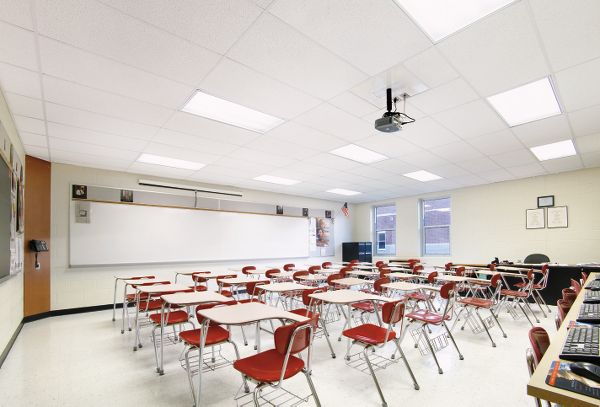
In classrooms where ceiling heights are less than ten feet, the best option is to place most, if not all, of the sound-absorbing material on the ceiling. To reduce reverberation, choose a ceiling panel that has a Noise Reduction Coefficient (NRC) of at least 0.70.
Armstrong has the perfect choice: School Zone™ Fine Fissured ceilings. Designed specifically for educational facilities, this ceiling features greater impact resistance and better noise absorption than most ceiling panels commonly used in these applications. Armstrong Ultima®, Mesa™ and Fine Fissured ceiling tiles are also good choices.
When ceiling heights are greater than ten feet, include an increasing amount of sound-absorbing material on the walls. Armstrong Soundsoak® Acoustical Wall Systems hit the mark here. Depending on the substrate and the mounting, these one-inch thick, vinyl or fabric-covered-panels absorb 50 – 90% of the sound striking their surface.
On-Line Reverberation Calculator
To help demonstrate the beneficial effect of acoustical treatment in a classroom, Armstrong has developed a web-based, interactive Reverberation Calculator that allows you to actually hear the difference in sound quality before and after treatment. It will even provide recommendations for a new space or an upgrade to an existing space.
To access the calculator, simply log on to armstrong.com/reverbtool and follow the prompts regarding a description of the space and its surface materials.
Reducing Noise Traveling Through the Plenum – Many walls stop at the level of the suspended ceiling, rather than extending up to the deck. As a result, noise in an adjacent room can penetrate the plenum and move unimpeded above all the rooms. Some of this sound can pass back down through the ceiling into adjoining rooms.
To help reduce this noise intrusion, choose an acoustical ceiling panel that has a Ceiling Attenuation Class or CAC of 35 or higher. Once again, Armstrong School Zone Fine Fissured is a good choice because not only does it have high NRC of 0.70, but also a high CAC of 40. Most Ultima, Mesa and Fine Fissured ceilings feature a CAC of 35.
Retrofitting Existing Classrooms
Acoustical problems in existing classrooms can be solved, but the options are often limited. That’s because little can be done to change the architectural infrastructure without great expense. Consequently, the most common and affordable solution is to control reverberation time through the addition of sound absorptive materials.
Installing an acoustical ceiling in a classroom that does not have one will greatly reduce reverberation time. If a suspended ceiling is already in the room, check the acoustical values of the ceiling panels. Replacing them with panels with a higher NRC will improve the acoustical environment. The addition of wall treatment will further improve it.
Open Plenum Spaces
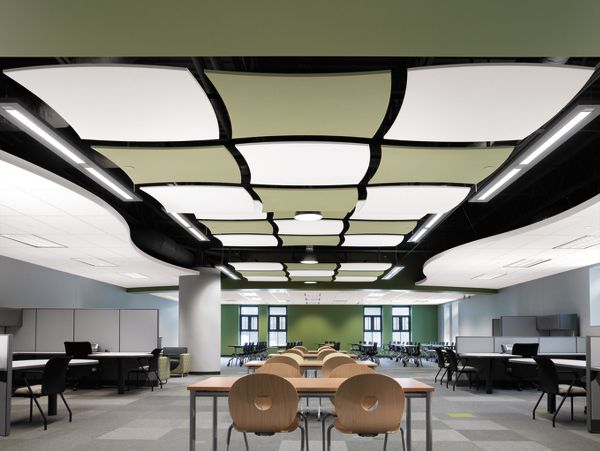
Another retrofit option, especially in open plenum spaces where the HVAC, plumbing and other building services are exposed, is the Optima® Capz™ ceiling system from Armstrong. This system is an affordable way to retrofit poor acoustic-performing spaces because it provides excellent sound absorption while maintaining the look of open plenum spaces. Installation over only 20% of an area can reduce undesirable reverberation by 50%.
Yet another solution for open plenum spaces is Formations™ and SoundScapes® acoustical clouds and canopies, two types of “free-floating” ceilings from Armstrong that also add sound absorption while allowing the exposed look. Quiet Classrooms
There are a myriad of Armstrong ceilings to help create classrooms with high acoustic performance. Choose them properly to ensure that any newly constructed or retrofitted classroom provides an acoustic environment that enhances the learning experience for students and teachers alike.
If you have questions about acoustics in classrooms as well as in other areas of a school, we can help. Just call 1-877-ARMSTRONG (1-877-276-7876) or visit armstrong.com/schools.

Information courtesy Armstrong
|
 Building Maximizer Newsletter from Building Operating Management