Building Maximizer Newsletter from Building Operating Management
 | Building Maximizer Newsletter from Building Operating Management |
Add buildingmaximizer@buildingoperatingmanagement.com to your address book to guarantee delivery. |
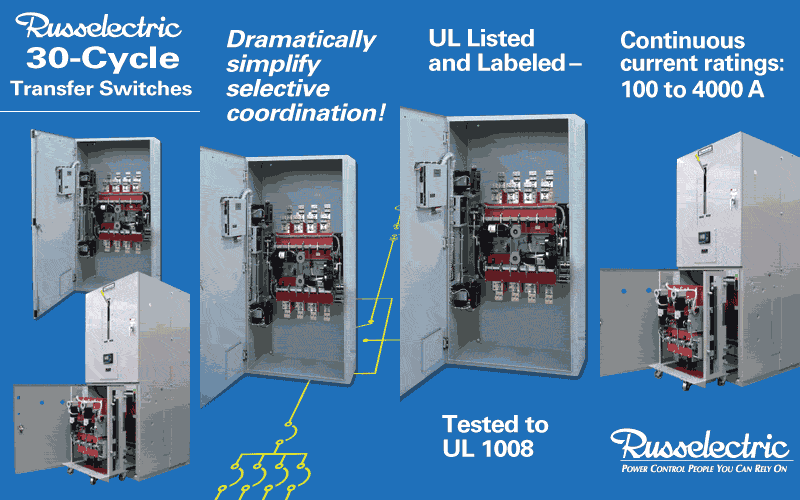
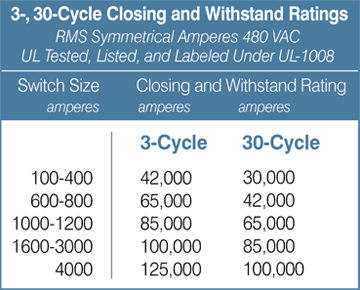
No other manufacturer offers such a comprehensive line of 30-cycle rated switches. All Russelectric 30-cycle switches are UL labeled and listed for 30-cycle closing and withstand ratings based on actual testing per UL Standard 1008. Because a 30-cycle closing/withstand test is optional under this standard, specifiers and purchasers of 30-cycle switches should carefully scrutinize the manufacturer’s ratings to make sure they are based on performance values determined by actual UL short-time testing. Selective CoordinationRecent changes to the National Electrical Code® (NEC) require selective coordination of overcurrent protective devices in emergency and other legally required standby power systems at hospitals and other mission-critical facilities. This engineering task becomes easier with 30-cycle-rated transfer switches. Selective coordination, as defined in the 2008 NEC, is the “localization of an overcurrent condition to restrict outages to the circuit or equipment affected, accomplished by the choice of overcurrent protective devices and their ratings or settings.” It can be a complicated process of coordinating the ratings and settings of circuit breakers or fuses to limit overcurrent interruption (and the resultant power outages) to the affected circuit or equipment (the smallest possible section of a circuit). Selective coordination is best done on the drawing board, at the beginning of the design process. Although achieving genuine, documented selective coordination can be time-consuming and expensive, flawed selective coordination is even more so in the long run. A proper selective coordination plan must consider, for every pertinent circuit, the full range of maximum available overcurrents, including overloads, all types of faults, and short circuits. In a system using circuit breakers, the breaker for every load circuit must have the proper rating, interrupting capacity, and setting for the point at which it is installed, based on the highest potential overcurrent from either power source (normal or backup). Progressing “upstream” through the circuit paths, from the smallest load branch circuit all the way to the normal and backup power sources, the plan must ensure that every circuit breaker has a higher overcurrent rating and a longer time-delay than the one below it, so that every overload/fault will be cleared by the breaker farthest “downstream” (the breaker immediately “upstream” of the problem). Numerous modifications of the NEC requirements have been adopted by local and state governments with varying degrees of enforcement, but let designers be forewarned: It is far better to err on the side of too much protection than not enough. The specifier might be called upon to prove that the time-current curves for circuits in his/her selective coordination scheme comply with the NEC by not overlapping at the available fault current. Even in a locality where selective coordination requirements on the books are not enforced, a specifier and his/her engineering firm could be found liable for injuries suffered due to inferior selective coordination — for the life of the building! Hold That Line!Today, most transfer switch designs have only 3-cycle closing and withstand ratings. The ability to withstand fault current for 10 times that duration (one-half second) necessitates that 30-cycle transfer switches be mechanically stronger by orders of magnitude. Because of its function — switching from normal to backup power and back again — a transfer switch is obviously in a key location, and its ability to withstand a fault condition is vital to supply power to the served load. In the event of a fault, a transfer or bypass/isolation switch that can withstand 30 cycles of overcurrent is like a sturdy defensive lineman in a football game. Holding the line long enough to allow the coordinated overcurrent protection to interrupt the fault, a 30-cycle switch assists in protecting downstream equipment, such as expensive medical devices. The new Russelectric RTS Series transfer switches dramatically simplify the specification and selective coordination of overcurrent devices. A switch that closes on and withstands 30 cycles of fault current is considered to be coordinated with any circuit breaker having short-time overcurrent protection (not instantaneous). If transfer switches are being protected by circuit breakers with short-time overcurrent protection only, and the switches have only 3-cycle closing and withstand ratings, they are not properly coordinated with their protective breakers. It’s All About PerformanceAnother major benefit of 30-cycle transfer switches is the extra capacity they provide for later expansions of electrical systems. The design phase of a renovation that upgrades available fault current or replaces overcurrent protective devices will proceed more smoothly if 30-cycle switches are already installed. Cost is always a consideration in the choice of any piece of equipment. In the final analysis, however, a transfer switch is a key component in an emergency/backup power system designed to protect lives and/or vital assets. Because the switch serves such a critical function in the system — for both normal and emergency loads — and because the potential losses from any malfunction are so great, the cost of the switch should be secondary to its performance. With this in mind, system designers and owners should insist on the best switch they can find. And given the robustness of its design and construction and its proven ability to withstand 30 cycles of punishment, a 30-cycle rated switch makes perfect sense. Russelectric RTS Series transfer switches are available in single- and dual-motor versions. Also available are 30-cycle rated RTS Series Bypass/Isolation Switches, in load-break bypass and no-load-break configurations. Featuring front-accessible wiring, rapid arc quenching, and SCADA compatibility, RTS Series transfer switches are also equipped with the industry’s most powerful, most versatile microprocessor-based transfer control system. For ease of application, performance, flexibility, and long life, nothing comes close to Russelectric RTS Series switches.
For more information, contact Russelectric Inc., 1-800-225-5250, TEL: (781) 749-6000, e-mail: info@russelectric.com, www.russelectric.com. |
Information courtesy of Russelectric Inc.
Unsubscribe | Subscribe a colleague | Privacy Policy |