Using Portable Air Conditioning for Emergencies, Cost Savings and Sustainable Solutions
Building owners, facility managers and maintenance supervisors can benefit from knowing how to choose and use portable cooling equipment for a gamut of applications. While emergency backup remains the number one use for portable cooling, these versatile units can be effective in reducing costs, saving energy, and/or solving difficult heat-related and comfort challenges year-round.
» Read our white paper for more information
Developing an emergency cooling plan for summer
- Pinpoint areas to be cooled. Emergency portable cooling is most often used for critical applications within hospitals, nursing homes and other healthcare facilities that are not equipped with 100% emergency power, and for telecommunications and server rooms to keep computers and other vital equipment functioning.
- Make sure there is a backup generator that will provide sufficient power for portable cooling. Many times, backup generators are not large enough to power the central A/C system. Spot cooling of critical areas offers an effective alternative – but even though electrical requirements will be reduced, you will still need adequate generator power to do the job.
- Consider special vulnerabilities. Power outages are not the only factor to consider. Rooftop air handlers or other outdoor equipment may be vulnerable to breakdowns due to damage from fallen trees or airborne debris during windstorms. It is a good idea to have portable backup cooling equipment “on call” in these situations
- Look for nearby power outlets with the required voltage and phase. If they are not available, determine the requirements for electrical cables, extension cords or other accessories.
- Establish a written emergency cooling plan using the information collected above. It should include a list of areas to be cooled, a full inventory of the needed portable units and accessories, and emergency contact information for the portable A/C supplier.
- When possible, request equipment delivery before a hurricane or other anticipated event. When disaster strikes and panic mode sets in, the demand for portable cooling equipment exceeds the local supply. Ordering ahead is the best way to ensure that your facility will have the right equipment at the right time.
» Learn more on how to implement an emergency cooling plan
Temporary and Long-Term Applications
 Short-term or temporary applications for portable cooling include: Short-term or temporary applications for portable cooling include:
- Bridging the gap when the permanent A/C system is shut down for service, refurbishment or replacement, to keep building occupants comfortable and protect heat-sensitive equipment.
- Providing cooling during building construction or renovation projects where, again, central A/C may not be available. Portables can afford relief to construction crews and also facilitate work processes by controlling temperature and humidity.
- Special events: Tented weddings and parties require more cooling capacity than typical building applications because of the heat loads generated by large crowds. For outdoor events in open areas, evaporative cooling may be a cost-effective option.
Long-term or permanent applications include:
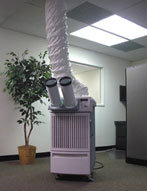
- Data centers, server rooms and telecommunications closets: Portable cooling is often used to protect heat-sensitive electronics. Portables on casters or ceiling-mounted units can be used either to provide primary cooling to isolated equipment rooms, or supplemental cooling to compensate for the heavy heat loads generated by this equipment.
- Night-time and weekend cooling during after-hours setback of the building thermostat: Portable units can bring considerable energy savings by delivering cooling only when and where it is needed.
- Supplemental cooling of growing businesses where the primary HVAC system is no longer adequate, or where tenants who rent space are prohibited by lease agreements from installing permanent A/C equipment.
- Reducing or eliminating capital expenditures: Portables are available for short- or long-term rental, averting capital expenditures. Even when purchased, portable units are sometimes only a fraction the cost of mini-splits or other unitary A/C systems.
» Click here to see case studies on portable cooling solutions.
Information courtesy of Atlas Sales & Rentals, Inc. |
 Building Maximizer Newsletter from Building Operating Management