Acoustical Ceilings: Perfect Prescription For Quieter Healthcare Environments
The right ceiling panels can improve the healing environment, reduce staff stress, and help meet HIPAA requirements
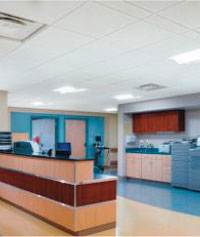
Hospitals are inherently noisy... for two reasons. First is the shear number of noise sources, ranging from paging systems and patient monitoring equipment to staff conversations and the clamor of visitors. Second, the walls, floors and ceilings tend to be hard surfaces designed for durability and cleanliness, but which also create excessive reverberation in spaces. Consequently, there is almost nothing capable of absorbing sound.
Unfortunately, noise can be a source of annoyance and stress to both hospital patients and staff, and can interfere with the staff’s ability to work effectively. That’s because hard sound-reflecting surfaces typical of older hospitals cause speech and activity sounds to persist much too long.
When acoustic conditions are characterized by long reverberation, spoken words overlap, resulting in reduced speech intelligibility. To make themselves heard, staff then need to raise their voices, compounding the noise issue.
Improving Speech Intelligibility
The amount of reverberation in a space is largely determined by the presence of sound-absorbing materials in a room. And, research has shown that the installation of high performance sound-absorbing ceiling tiles results in reduced reverberation as well as reduced perceptions of noise and annoyance. They also help improve speech intelligibility and reduce work stress among the staff.
Speech intelligibility is especially key in healthcare settings because nurses and physicians must constantly comprehend and act based on their conversations in a highly stressful environment. The ability of staff members to verbally communicate with each other and with patients is also a factor in patient safety because high noise levels can lead to distractions and a loss of focus, resulting in miscommunication and possible medical errors.
Portfolio of Acoustic Solutions
To help reduce noise levels and reverberation time, Armstrong offers a portfolio of acoustical ceiling tiles and ceiling panels that also meet hospital standards for washability, anti-mold, anti-microbial, and fire safety.
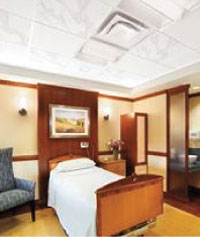
New Health Zone™ Ultima® and Optima® ceilings, for example, offer the first ceilings made in the USA that combine a water-resistant, scrubbable surface with excellent sound absorption, making it an ideal choice for patient rooms, treatment rooms, and other spaces that require a balance of cleanliness and quiet.
In public spaces like lobbies and waiting rooms, Armstrong WoodWorks® wood ceilings can help impart a warm ambiance to a space. Wood ceilings are available in a variety of sizes and finishes and can be perforated to provide acoustical control.
Other acoustical ceiling options for public spaces include Armstrong MetalWorks™ metal ceilings and Armstrong Formations™ and SoundScapes® “free floating” ceiling clouds and canopies.
Metal ceilings can impart a very high tech or sophisticated look to a space and can also be perforated for acoustical performance. Acoustical clouds and canopies offer an aesthetically pleasing visual while helping to reduce reverberation in the space below them.
Protecting Patient Privacy
A reduction in noise levels and reverberation, however, is not the only function acoustical ceilings can provide. In current healthcare settings, patients are often exposed to situations where they overhear conversations about other patients. Or, they have their own private information communicated in an environment where it can be heard by others. Here, research shows that such scenarios are likely to impact patients’ trust and their ability to discuss their health problems freely with their physicians, which can have serious implications on their care. It is critical, therefore, that private conversations with or about a patient are not overheard. To help ensure confidentiality, the Health Information Portability and Accountability Act (HIPAA) mandates that all individually identifiable patient information, including information communicated orally, be kept private.
Attaining Speech Privacy
As in the case of speech intelligibility, attaining speech privacy is dependent on good acoustical design and the selection of interior systems and materials. In that regard, the right ceiling choice can serve to both limit the sound intrusion between spaces, and affect the quality of sound within a space. The ceiling is therefore a key element in creating an acoustical environment that can maintain speech privacy. And, when it comes to complying with HIPAA regulations, Armstrong Health Zone Ultima, High CAC Ultima, Cirrus®, and Mesa™ ceilings can all provide the acoustical sound blocking needed for patient privacy in adjacent rooms when the walls do not extend to the deck above.
New Design Guidelines
When choosing ceilings for healthcare institutions, two helpful reference tools are the Green Guide for Health Care™ (GGHC) and the AIA 2010 Guidelines for Design and Construction of Health Care Facilities, both of which address acoustical issues.
If you still have questions about speech privacy, speech intelligibility, or any other issue dealing with acoustics and noise in healthcare environments, we can also help. Just call 1-877-ARMSTRONG (1-877-276-7876) or visit armstrong.com/healthcare.

Information courtesy Armstrong
|
 Building Maximizer Newsletter from Building Operating Management