Building Manager's Guide to Submetering
the "Green Facility" Environment
Today's savvy building owners and operators are seeking cost-effective ways to help them proactively manage their energy consumption and demand profiles. Among the top tools in the high-tech arsenal are submeters and energy intelligence software. This white paper presents an overview of submetering for the green facility environment with an eye to how facility operators cans deploy them to help relieve bottom-line pressure.
Installed on the "facility side" of the traditional glass-covered utility meter, submeters have proven themselves to be effective tools for monitoring, diagnosing and preventing bottom line-impacting problems associated with the facility's energy envelope. When combined with energy intelligence software, submeters provide insight on a building's flow and consumption of electricity. In today's cost-conscious green facility environment, obtaining such knowledge has become more important than ever.
The following sections describe how submeters can be used in different green facility environments to help facility operators get a real handle on their energy demand and usage profiles.
Multi-Tenant: Commercial & Residential Facilities
Managers of multi-tenant facilities must keep tenants happy while showing the property owner that building efficiency, occupancy rates and profitability are all in line. Without submetering, the building manager allocates energy costs and Common Area Management (CAM) charges, depending on the lease agreements, based on tenant use or some ratio of x dollars per square foot of space. Providing solutions for tenants to control their utility costs helps keep them as satisfied, long-term tenants. In these situations, submeters and energy intelligence software can be installed to monitor actual electrical consumption by both tenants and common areas, track energy use and help facility managers analyze the data to identify areas for cost savings.
Building managers can sell submetering to management by pointing out that metering provides a fair allocation of the building's electricity costs among tenants who are only responsible for the electricity they use, not their neighbors'. Submeters also put control back in the hands of the tenant — the more they conserve, the less they pay.
Institutional & Government Buildings
Whether the facility is institutional, educational or government-owned, a primary concern is identifying and allocating energy costs for various tenants. In these settings, facilities can range from housing or administration buildings to dining facilities and buildings with outside tenants. If submeters are already monitoring tenants' energy use, managers can utilize this existing equipment and install energy intelligence software to identify usage patterns and pinpoint possible inefficiencies, in addition to creating tenants' monthly bills.
A good example of the opportunities provided to electrical contractors is the Energy Policy Act of 2005 (EPAct 2005), which says that by 2012 all 500,000+ federal buildings must be metered or submetered. Contractors can help obtain data that must be provided at least daily; install meters that must measure at least hourly consumption of electricity; and incorporate the data into existing federal energy tracking systems made available to federal facility managers.
Manufacturing & Industrial Plants
Plant managers at manufacturing and industrial facilities might already be familiar with submetering, but they may not realize the benefits associated with adding energy intelligence software. Plant operators require accurate, real-time status feedback to evaluate the performance of pumps, compressors, heaters, chillers, conveyors and other electrically powered equipment. By installing energy intelligence software, managers now have insight into deteriorating or problematic equipment when a particular load increases more than normal. Other benefits for plant managers include accurate allocation of energy for product runs, production lines of equipment or departments.
Submeters provide plant managers with vital data on energy usage, power quality and peaks, or shifts in power supply, that can help them address these power trends with their utility provider. With regard to internal plant operations, submeter data can also be used for tracking and allocating energy consumption costs across departments and/or manufacturing lines.
Submetering for LEED v3 Credits
LEED v3's energy section offers some of the building assessment system's most targeted guidelines for decreasing energy consumption and increasing alternative energy use. LEED v3 also provides guidance on commissioning, so that facility executives can be sure their systems are functioning at peak efficiency. The backbone of the measurement and verification (M&V) process required for LEED certification at every level is the electric sub-meter. The primary building performance category in which submetering plays a key role is the Energy & Atmosphere (EA) subset that runs through most, if not all, major assessment categories, including Commercial Interiors (CI), Core & Shell (CS), Existing Buildings-Operations & Maintenance (EBOM), New Construction (NC) and Schools.
Meter Dashboards Increase Energy Awareness
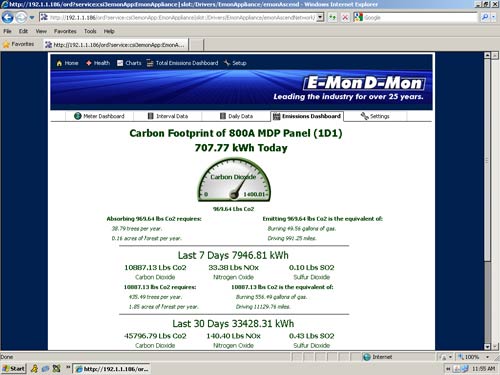
Internet-enabled energy monitoring and data presentment dashboards are gaining traction in the facility environment for displaying kWh, kW, peak demand, power factor and other energy measurements in real time, and historically, while also displaying the facility's "carbon footprint." This allows facility occupants to monitor their building's carbon dioxide (CO2), sulfur dioxide (SO2) and nitrous oxide (NOx) emissions — while at the same time observing estimated energy conservation measures needed to compensate for the displayed levels. The following screen capture illustrates the sheer depth of energy information provided by a single submeter, in this case an E-Mon D-Mon Class 3000 device. For an 800 Amp main distribution panel, the meter dashboard displays the carbon footprint of the metered panel over time, even extrapolating the data to an estimation of equivalent automobile miles driven and the amount of reforestation needed to offset the panel's CO2 contribution!
 |
The Bottom Line is Still the Bottom Line
The type of energy data needed by today's sophisticated facility is beyond the capability of the master utility meter to provide. As first-level data gathering tools in the facility load-profiling process, submeters provide high-accuracy 15- or 30-minute snapshots of energy use (kWh) and demand (kW) — at the enterprise level all the way down to a specific circuit or item of equipment. Submeters are an easily installed, versatile and scalable solution for obtaining the degree of energy intelligence granularity needed to optimize today's facility operations — no matter what type of facility is being monitored.
For further information about E-Mon's complete line of hardware and software solutions for automatic meter reading applications, visit www.emon.com/boma1010.asp or call 1-800-334-3666.
Information courtesy of E-Mon, LLC
|
 Building Maximizer Newsletter from Building Operating Management