Green goes mainstream
Growing interest in environmentally-responsible technologies sparks growth for 3M™ Novec™ 1230 Fire Protection Fluid
After years of political wrangling, regulations to restrict greenhouse gas emissions are finally beginning to emerge. That's the assessment of Craig Schwartz, business director, 3M Electronics Markets Materials Division. And this development has not been lost on builders, boat and airplane manufacturers and others who purchase fire protection systems, resulting in surging sales of 3M™ Novec™ 1230 Fire Protection Fluid.
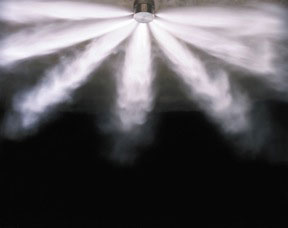
Clean extinguishing agents such as Novec 1230 fluid occupy a major niche in the fire protection market. In buildings that house delicate, high-value assets — such as computers, telecommunications equipment or irreplaceable works of art — the use of conventional water sprinklers can be even more damaging than an actual fire. These kinds of facilities typically rely on chemical fire suppression systems that quickly knock down the blaze, but don't harm the room's contents. But until recently, such systems used agents with high global warming potential (GWP) — because few customers were choosing an agent based on its environmental impact.
"The only customers who looked for low-GWP agents were those who recognized the value in making a purchasing decision based on the product's impact on the environment — the true believers," says Schwartz. "Now, with growing recognition of the need to reduce greenhouse gas emissions, it's much easier to find those true believers."
As customers seek out products and materials with a low global warming impact, they have begun to discover Novec 1230 fluid. This proprietary 3M product has an atmospheric lifetime of five days and a GWP of one, about the same as naturally-occurring carbon dioxide. Among comparable chemical agents, the next best has a GWP of 3,220 and an atmospheric lifetime of 34 years. Novec 1230 fluid also has the widest margin of safety of any viable chemical agent, meaning short-term exposure to it is safe for humans.
A new approach to chemical development
The genesis of Novec 1230 fluid, according to Schwartz, can be traced back two decades, when government stepped in to solve a different environmental problem. "The Montreal Protocol was signed in 1987 to regulate ozone-depleting substances," he says. "We felt if the nations of the world could do that, then greenhouse gases — associated with global warming — could be next."
3M responded by developing a number of new, low-GWP molecules for several applications. There were no immediate regulations driving this effort, Schwartz recalls. "But we thought it was the right thing to do. And we saw an opportunity to reposition our products as the environmentally sustainable solution."
The first fluids marketed under the Novec brand, for cleaning and heat transfer applications, were launched in 1996. Five years later, 3M researchers discovered another molecule that vaporized rapidly, was nonconductive and noncorrosive, and didn't leave behind a residue. "That made the chemical ideal for extinguishing fires in places containing high-value assets," explains Joe Koch, business manager, 3M Electronic Markets Materials Division, "such as data centers or telecom switching centers."
In 2003, after two years of testing and system development, 3M™ Novec™ 1230 Fire Protection Fluid was launched. The market's reception was very positive, with solid growth in electronics applications as well as several high-profile museum installations, including the Alamo and the Library of Congress. Novec 1230 fluid has also been popular in aircraft, marine and oil and gas applications, and was recently specified as the extinguishing agent for engine compartments in the new Airbus 350 passenger jet.
Preparing for the inevitable
That initial interest in Novec 1230 fluid has accelerated in the past few years, Koch explains, as customers have decided that tough new greenhouse gas regulations are imminent.
"California could be enacting regulations within the next two years, and there's a good chance that federal regulations will also be passed," he says. "Even if you think the regulations are five or six years away, that affects how you design a building that should last 20 or 30 years." Koch explains that tighter regulations could lead to the banning of certain high global warming compounds — similar to what happened in 1987 with ozone-depleting substances. "Suppose you have a discharge 10 years from now. If your system were designed around an agent with a high GWP, you have to ask yourself, will it still be available to refresh the system? If so, will it be prohibitively expensive or restricted? And even if you never discharge the agent, how will you dispose of it when the time comes to renovate or replace the building?"
As evidenced by the rapidly-growing sales of Novec 1230 fluid, more and more building owners and designers are thinking through these very questions. And they are reaching the conclusion that choosing sustainable, "green" technologies — like Novec 1230 fluid — is not just responsible thing to do; it also makes good business sense. |
 Building Maximizer Newsletter from Building Operating Management