E-Mon D-Mon® Submeters Help Spectrum
Engineers Get LEED-CI 'Platinum'
With locations in Salt Lake City and Phoenix, multi-disciplinary Spectrum Engineers specializes in client-centered, integrated facility engineering services, including designing for sustainability. As a demonstration of the company's own high-tech, cutting-edge capability, the decision was made to certify Spectrum Engineers' offices under the USGBC's LEED-CI (Commercial Interiors) building assessment rating system. As part of the multi-faceted LEED certification process for Platinum—the highest LEED-rating level—a network of electric submeters was integrated into the Building Automation System (BAS) to monitor a broad range of facility performance parameters—36 in all—at both Spectrum locations. In the Salt Lake City office alone, 27,379 square feet of space are being metered.
To achieve their goals, Spectrum specified E-Mon, LLC of Langhorne, PA, a leading supplier of electric submeters and automatic meter reading (AMR) systems and services. GT Sales, E-Mon's Salt Lake City rep, and Winlectric, the local E-Mon distributor, were instrumental in coordinating the purchase and delivery of the metering equipment to Spectrum's electrical contractor. During the design phase, Sim Gurewitz, E-Mon's regional manager, worked closely with Spectrum to ensure the seamless integration of the system's eight E-Mon D-Mon Class 3000 submeters with the facility's BACnet building automation system. Communicating the raw energy data via Ethernet to the BAS, the energy data is used for in-lobby display in both offices, as well as for energy analysis by Spectrum Engineers.
Metering Hardware?
The heart of the submetering system is the E-Mon D-Mon Class 3000 Advanced Meter, a low-cost, intelligent meter with advanced functions, including scrolling displays of consumption in kilowatt hours (kWh), demand in kilowatts (kW) and other real-time functions. Recording on two channels, the meter is capable of storing demand and consumption data in five or 15-min intervals for up to 12 or 36 days, respectively.
The energy data is captured via 0-2V output split-core current sensors, which are quickly installed, without power interruption, up to 500 feet from the electrical panel they are monitoring. A strong advantage of the Class 3000 meter for measurement and verification (M&V) is the ability to accept pulse inputs from all types of utility meters, including water, gas, steam and BTU, and communicate these measurements to the BAS. Flexibility for almost any building system monitoring need is assured by the availability of standard communications options including telephone modem, pulse output, ModBus RTU and TCP/IP, Ethernet, LonWorks, and BACnet IP and MS/TP.
Performance Indications at Spectrum
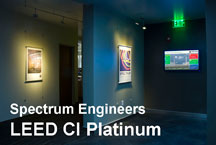
Spectrum Engineers' David Affleck is pleased with the submeters' performance monitoring capability. "Two selling points of the E-Mon system were its BACnet capability, which allows us to interface with our existing BAS, and the easy installation of the meters." The system's been running for about six months now, providing an attractive display of 36 building automation system parameters on a large flat-screen monitor in the front lobby. "Through this interactive medium," he said, "everyone at Spectrum Engineers has a stake in monitoring facility performance and becoming an equal partner in the energy conservation process."
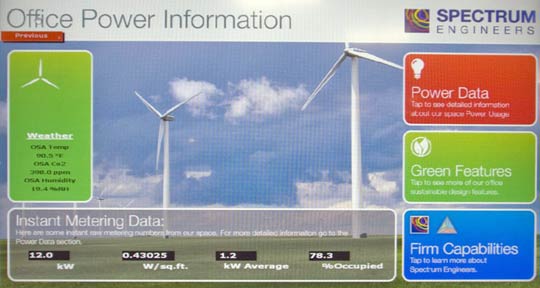 |
Spectrum Engineers integrated a network of E-Mon D-Mon electric submeters into the Building Automation System (BAS) to monitor a broad range of facility performance parameters at both company locations. Flat-panel screen in Spectrum Engineers' front lobby shows current weather conditions and real-time displays of demand (kW) and other metered parameters. At right, interactive features guide users to a number of colorful subscreens illustrating Spectrum's total energy profile in real time. |
A high-definition screen in the lobby displays the information collected by the E-Mon D-Mon Class 3000 meters, including a real-time snapshot of: delivered energy (kWh), real power (kW), apparent power (kVA), power factor (%), current load (A) and line-to-line Voltage (V) for the following building systems:
- Heating
- Lighting
- Air Handling
- Domestic Hot Water
- Back-up Power (UPS)
- Plug Load
Submetering for LEED Points in Commercial Interiors (CI)
On the cutting edge of sustainable facility design, Spectrum has seen first hand the value that submeters add for the precise measurement and verification needs of LEED, Green Globes and other high-performance building assessment systems.
In LEED-CI certification processes like Spectrum's, submetering equipment is useful for a variety of functions. For example, commissioning agents can use energy intelligence software like EmonEnergy to monitor and analyze the functionality and performance of electric, water and gas systems. In new construction, submeters are useful for baselining facility energy performance, and also in renovation scenarios where at least 12 months of energy data can be collected to provide a highly accurate profile of the facility's energy patterns over time. In addition to LEED's New Construction (NC) and Core & Shell (CS) categories, submeters are extremely useful for obtaining points in the Energy and Atmosphere section of the Commercial Interiors (CI) category, as shown in Table 1.
LEED 2009 Commercial Interiors (CI) Submetering Points Chart
Section Title & Credit |
Credit Description |
Points |
Credit Intent |
Energy & Atmosphere (EA) Prerequisite 1 |
Fundamental Commissioning of Building System |
0 |
Verify project's energy-related systems are installed and calibrated according to project documentation |
EA Prerequisite 2 |
Minimum Energy Performance |
0 |
Establish minimum energy-efficiency level for tenant space systems to reduce economic impact of higher energy use on environment. |
EA Credit 2 |
Enhanced Commissioning |
Up to 5 |
Verify and ensure that the tenant space is designed, constructed and calibrated to operate as intended. |
EA Credit 3 |
Measurement and Verification (M&V) |
Up to 5 |
Provide for on-going accountability of building energy consumption over time. |
EA Credit 4 |
Green Power |
Up to 5* |
Encourage development and use of grid-based renewable energy sources on a net zero pollution basis. |
Regional Priority
Credit 1 |
Regional Priority |
Up to 4 |
Provide an incentive for achieving credits that address geographically specific environmental priorities. |
*Up to 2 in LEED for Retail system |
Source: E-Mon, LLC |
Table 1. Specific LEED Version 3 Commercial Interiors (CI) sections and potential points facilitated by the use of E-Mon D-Mon electric submeters. |
Conclusion
Recent industry studies show that green building construction will continue to be a major trend across the facility landscape. An enabling technology, submeters can help facilities improve their bottom lines by benchmarking, measuring and verifying compliance with major energy initiative guidelines, while also encouraging every level of the enterprise to become a stakeholder in the energy management and conservation process. Spectrum Engineers' LEED Platinum certification project is a case in point of how submeters are helping state-of-the-art buildings achieve sustainability, improve energy efficiency and encourage environmental stewardship throughout every level of the organization.
For more about E-Mon D-Mon electric submeters and E-Mon's complete line of automatic meter reading hardware and software solutions, call (800) 334-3666 or visit us on the Web at: www.emon.com/bom210.asp.
Information courtesy E-Mon, LLC
|
 Building Maximizer Newsletter from Building Operating Management